The concept of linear combinations of normally distributed variables is a significant topic in probability and statistics. This section delves into how these combinations maintain their normal distribution, an essential aspect of understanding real-world data distributions.
Understanding Normal Distribution
- Normal Distribution: A bell-shaped curve described by its mean and variance , used to model various real-world phenomena.
Linear Combinations in Normal Distribution
- Linear Combination: The process of adding variables together, each multiplied by a constant. It's a foundation in statistics for modeling and analysis.
Key Principle
- Linear Combinations of Normally Distributed Variables: If the variables are normally distributed, their linear combinations also follow a normal distribution.
- Single Variable: If , then is also normally distributed as .
- Two Independent Variables: For and , follows .
Examples
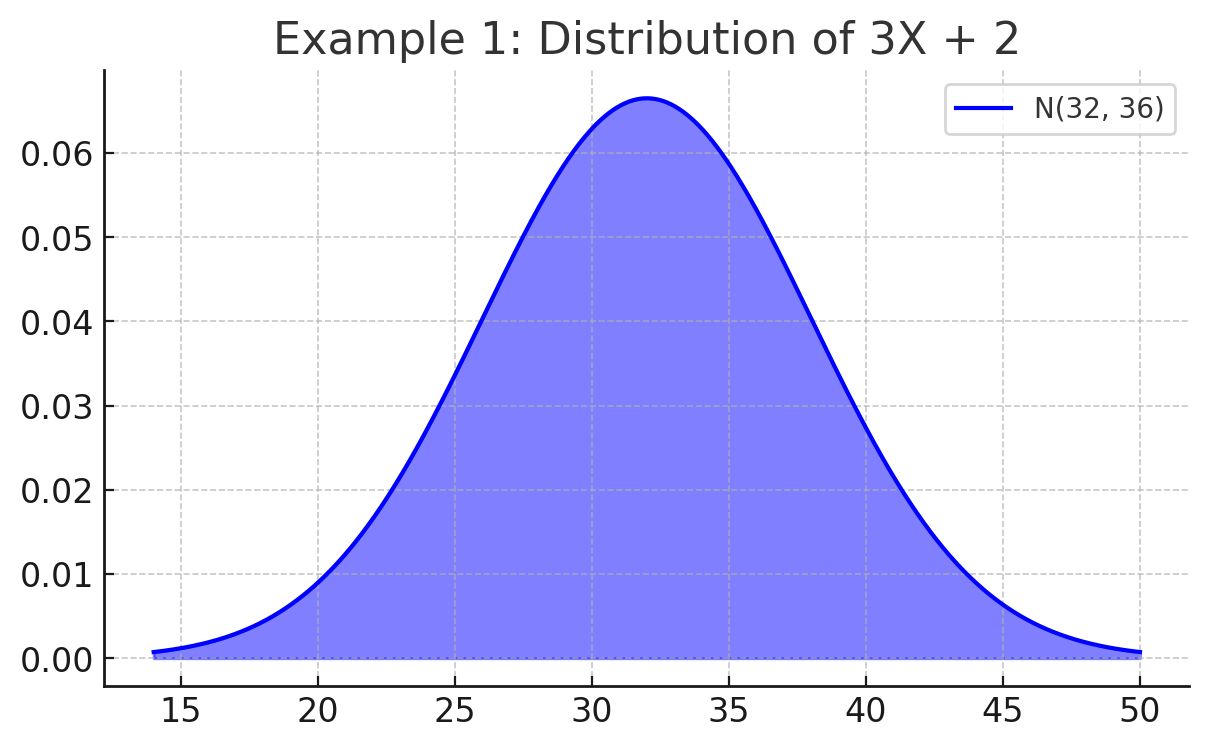
Example 1: Single Variable Transformation
Question: Given a normal distribution for a random variable , determine the distribution of the transformed variable .
Solution:
1. Mean of (3X + 2):
Calculated using .
With , it results in .
2. Variance of (3X + 2):
Determined by .
Given , this leads to .
Conclusion: The transformed variable follows a normal distribution .
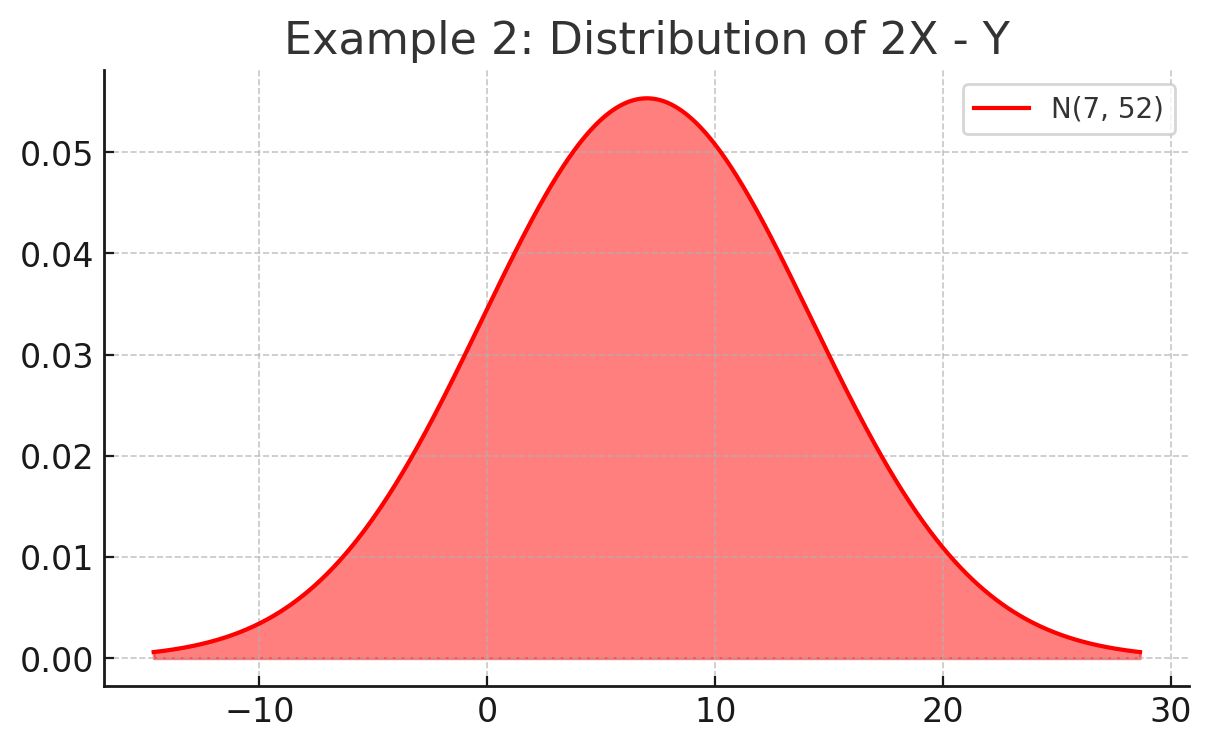
Example 2: Combination of Two Independent Variables
Question: What is the distribution of the variable if and are independent normally distributed variables with and ?
Solution:
1. Mean: The mean of is .
2. Variance: The variance of is
Conclusion: is normally distributed with .