Contents
Variance is a key concept in statistics, especially when dealing with random variables. Students need to understand how variance is calculated in linear combinations of random variables, as it forms the basis for more complex statistical analyses.
Understanding Variance
- Variance, denoted as , measures the spread of a set of numbers from their mean.
- It's the average of the squared differences from the mean.
Variance of a Single Random Variable
- Formula: , where 'a' and 'b' are constants, X is the random variable.
- 'b' does not affect variance, only 'a' does.
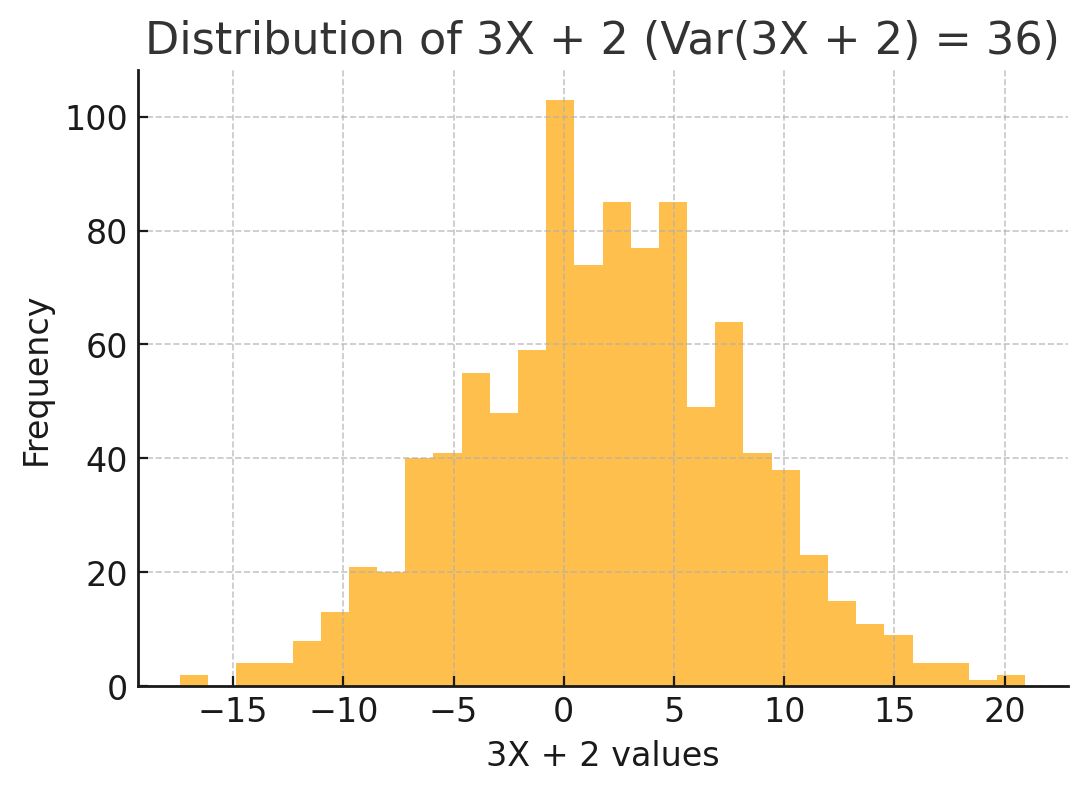
Example Calculation: Var(3X + 2)
Consider a random variable with a known variance, say . If we transform using a linear equation, for example, , the variance of this new variable is calculated as follows:
- Variance calculation: .
Variance of Linear Combinations of Two Independent Random Variables
- Formula: = , where 'a' and 'b' are constants, X and Y are independent random variables.
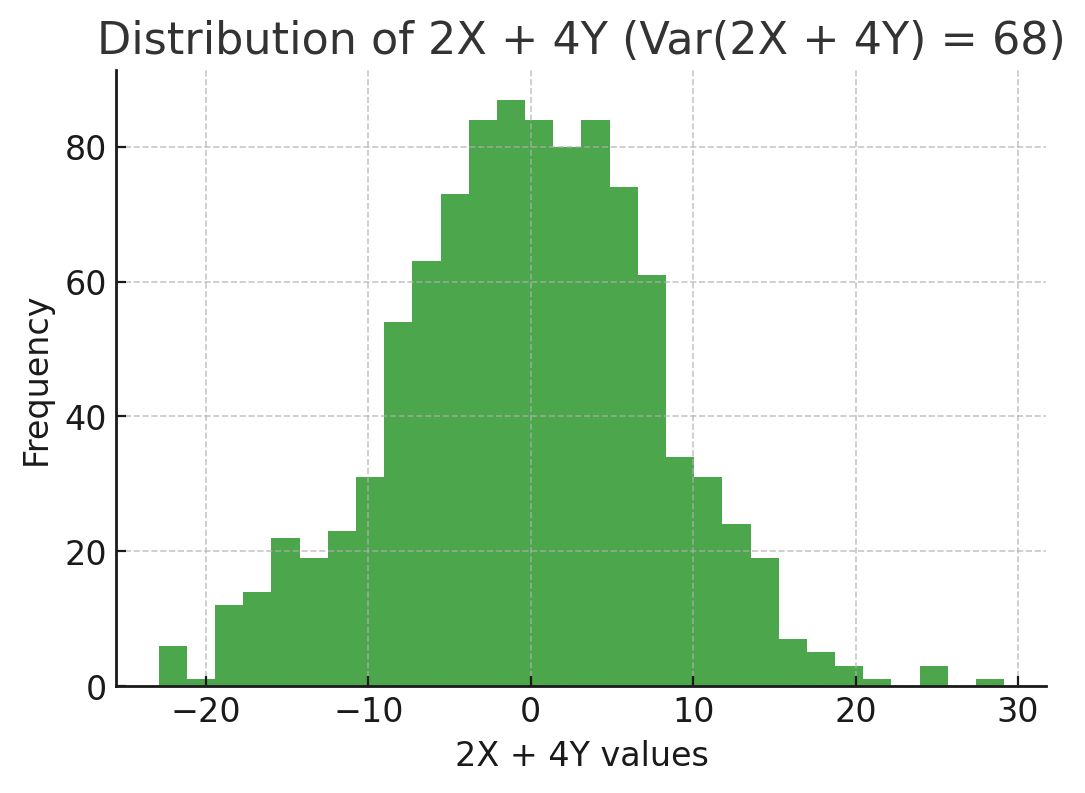
Example Calculation: Var(2X + 4Y)
Suppose we have two independent random variables, with , and with . For a linear combination, say 2X + 4Y, the variance is calculated as follows:
- Variance calculation: .