Contents
A critical area of study is the mean and variance of continuous random variables, derived from their Probability Density Functions (PDFs). This chapter explores the mathematical techniques and interpretations necessary for understanding and applying these concepts.
Overview of Continuous Random Variables:
- Continuous random variables differ from discrete ones by taking on any value within a range.
- They model scenarios with fluid changes, such as height, temperature, or time measurements.
Probability Density Functions (PDFs)
- Describe likelihood of a continuous variable assuming a specific value.
- Key properties:
- Non-negativity: PDF values are always non-negative.
- Total Probability: Integral of PDF over its range equals 1.
Mean (Expected Value) from PDFs
- Represents the central or average value of a distribution.
- Calculated as: .
Example:
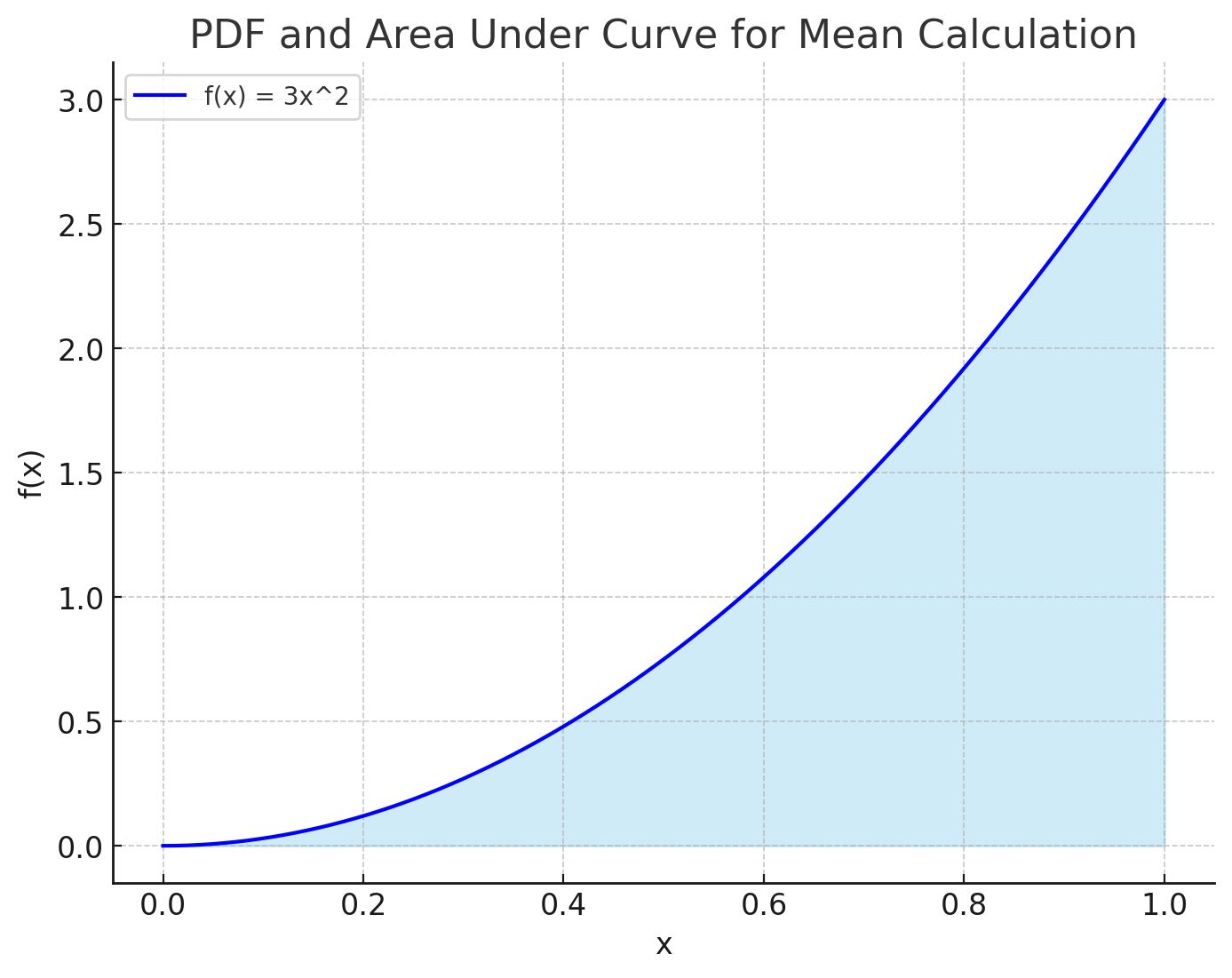
Find the mean of the PDF for .
Solution:
- Mean Formula: .
- Apply PDF: For , calculate .
- Simplify: The integral simplifies to .
- Integration: Evaluate to get .
- Result: Substituting the limits, .
Conclusion: The mean of the distribution is .
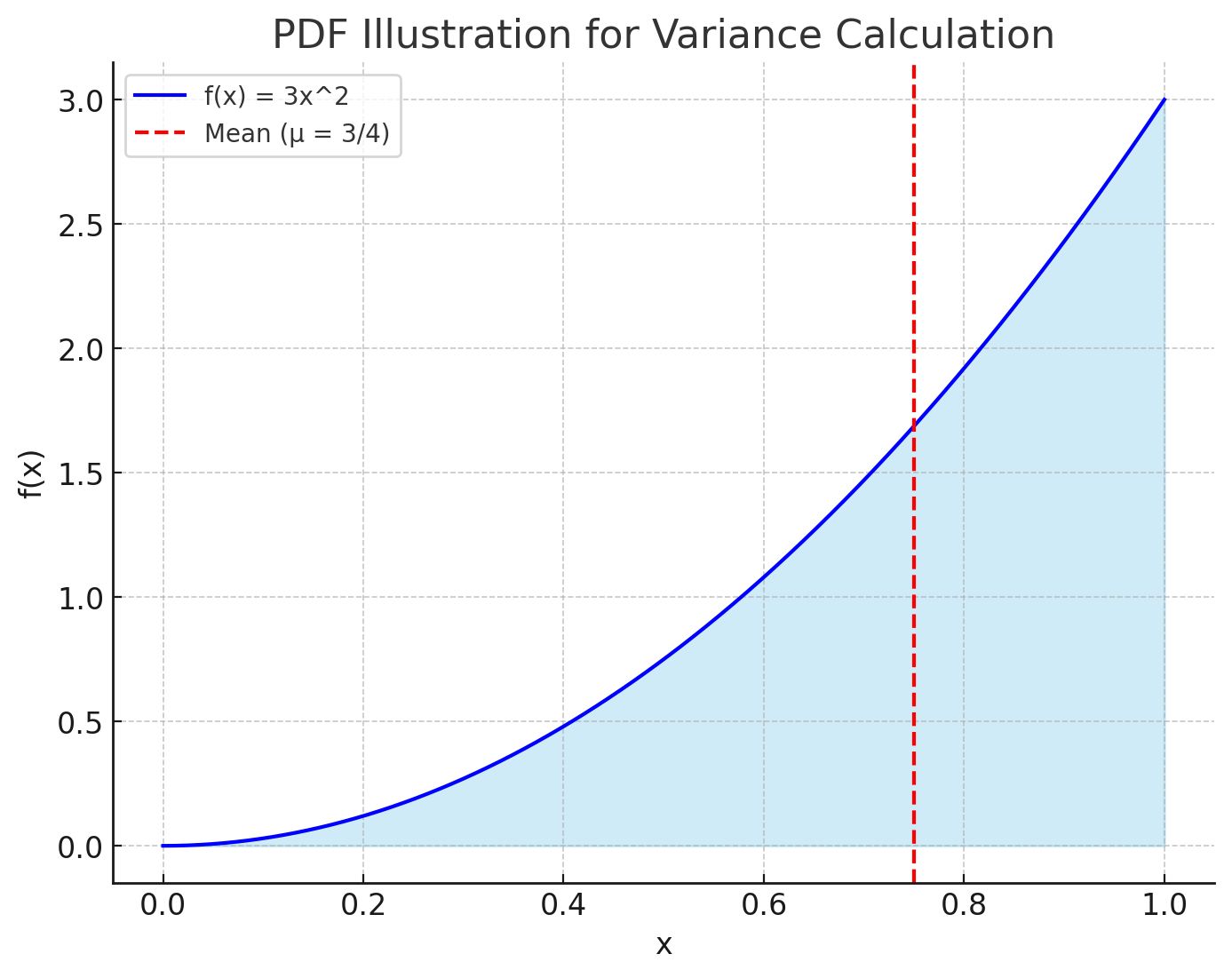
Variance from PDFs
- Measures the spread of values around the mean.
- Calculated as: .
Example:
Calculate the variance for the PDF .
Solution:
- Given Mean: .
- Variance Formula: .
- Apply to PDF: .
- Integration: Solve .
- Result: After computing the integral, .