Contents
This section focuses on continuous random variables, a fundamental concept in advanced mathematics. Distinct from discrete variables, continuous random variables can take on an endless array of values, which is crucial in areas like statistics and engineering. The focus will be on understanding continuous random variables, exploring the characteristics of probability density functions (PDFs), and defining the criteria for a valid PDF.
Continuous vs Discrete Random Variables
- Discrete Random Variables: Have specific, countable outcomes. E.g., the number of pages in a book.
- Continuous Random Variables: Can take any value within a range. E.g., a person's height.
- Key Difference: Discrete variables are countable; continuous variables span an infinite range within intervals.
Probability Density Functions (PDFs)
- PDF: Describes how likely a continuous variable is to take a certain value. Represented as .
- Characteristics of a PDF:
- Non-Negativity: for all .
- Normalization: The total area under the PDF (integral) equals 1: .
Valid PDF Conditions
- Non-Negative: Must be everywhere.
- Total Probability Equals 1: Integral over its domain equals 1.
- Real-Valued: Outputs real numbers.
Example: Validating a PDF
Example 1: Is a Valid PDF for in ?
Solution:
- Non-Negativity: True for in .
- Total Probability Equals 1: The integral of over its entire range must equal 1.
- Finding for Total Probability:
Evaluating this from 0 to 2:
Thus, the function for in is a valid PDF.
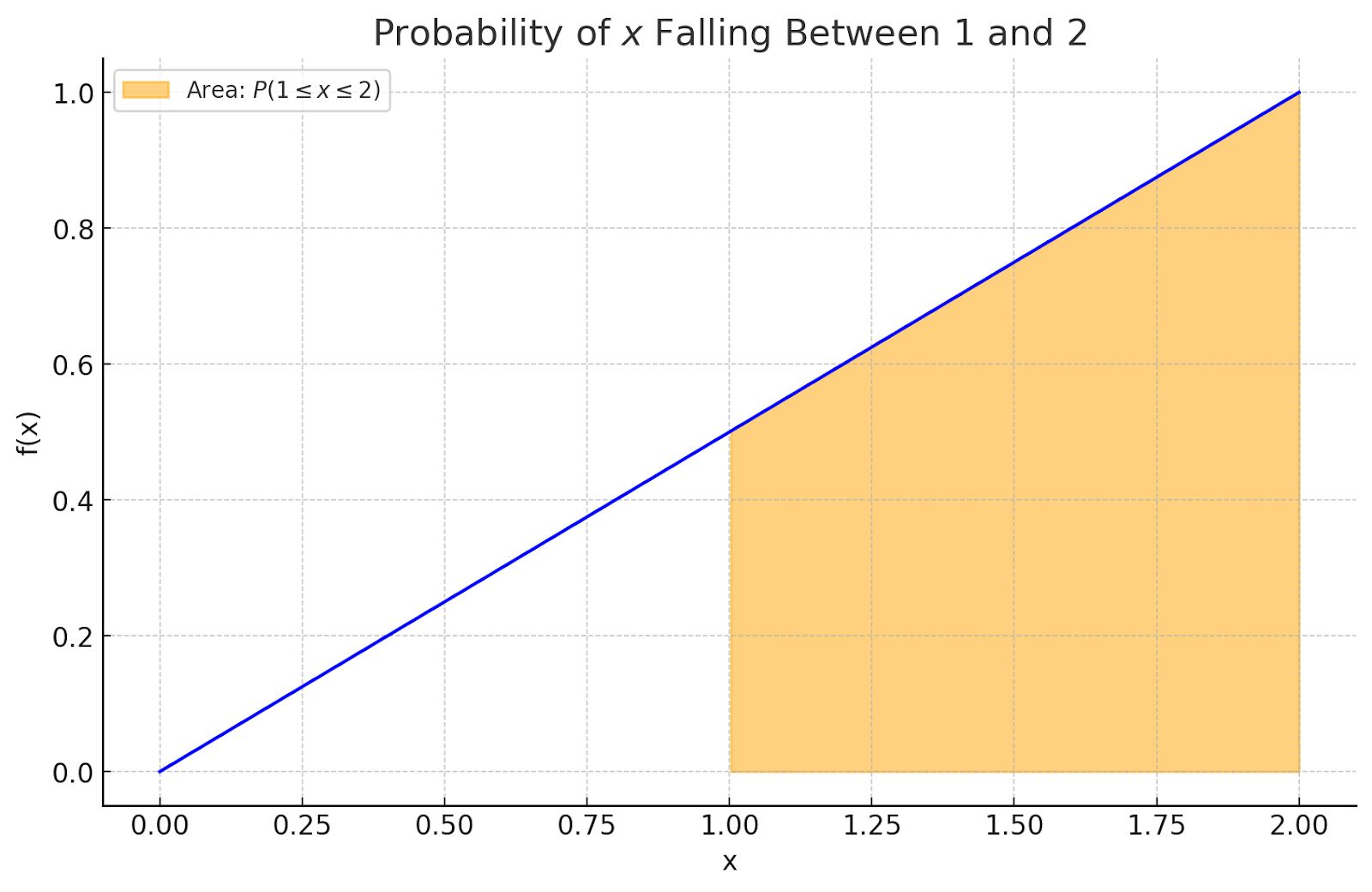
Example 2: Probability Calculation
Function:
Question: Calculate the probability that falls between 1 and 2.
Solution:
The probability is given by the integral of ( f(x) ) from 1 to 2:
Evaluating from 1 to 2:
Therefore, the probability that falls between 1 and 2 for our PDF is 0.75.