AQA Syllabus focus:
'The use of the cognitive interview to improve the accuracy of eyewitness testimony.'
The cognitive interview is a police interviewing method designed to increase the amount of accurate information witnesses remember by using psychological principles about how memory is stored and retrieved.
What the cognitive interview is
The cognitive interview was developed to improve the quality of eyewitness recall during police interviews. Traditional interviews often involved interruptions, closed questions, and pressure, which could limit recall or distort it. The cognitive interview aims to make retrieval easier and more systematic.
Cognitive interview — a structured interviewing technique that uses psychological principles to help eyewitnesses retrieve more accurate memories.
The method is based on the idea that memories are not always lost; sometimes they are simply hard to access. By supplying the right retrieval conditions, an interviewer can help a witness recover details that were not produced in a standard interview.
Why the cognitive interview should improve recall
The cognitive interview is rooted in research on retrieval cues. A cue is something that helps a person access a stored memory. If recall can be approached from different angles, the witness has more chances to retrieve useful details.
A key assumption is that memory is connected to:
the physical context in which an event happened
the witness’s emotional state
linked details within the original memory
the order and perspective from which the event is recalled
Because of this, the cognitive interview encourages several different ways of searching memory rather than relying on one simple question-and-answer format.
The four main techniques
Report everything
The witness is asked to mention every detail, even if it seems unimportant, incomplete, or irrelevant. Small details may act as triggers for larger memories.
This matters because:
one memory can lead to another related memory
details that seem trivial to the witness may be important to an investigation
witnesses sometimes censor information because they think it is not useful
Encouraging full reporting can therefore increase the amount of information recalled without the interviewer deciding in advance what matters.
Reinstate the context
The witness is asked to mentally recreate the original situation. This can include:
what the place looked like
sounds, smells, or weather
where people were standing
how the witness was feeling at the time
This technique is sometimes called context reinstatement.
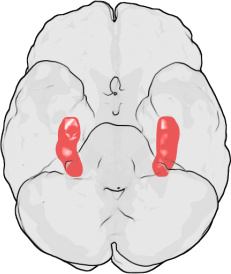
This labeled brain diagram highlights the hippocampus, a structure widely associated with episodic memory and contextual aspects of remembering. It provides a biological “hook” for why recreating the original context can aid retrieval: contextual information is often bound to the memory trace and can be reactivated during recall. Source
It works because memories are often linked to the surroundings and internal state present during encoding. Recreating those conditions in the mind can provide effective retrieval cues.
Recall events in a different order
Witnesses are often asked to describe the event in reverse order or to start from the middle and work backward or forward.
This can improve accuracy because:
it reduces reliance on a normal, expected story structure
it makes witnesses think more carefully about each moment
it can expose details that may be skipped in a rehearsed account
A standard forward narrative can be shaped by expectations about what “usually” happens. Changing the order makes this harder.
Change perspective
The witness may be asked to imagine the event from the viewpoint of another person who was present, such as another witness or the victim.
The aim is to access details through a different retrieval route. Thinking from another angle may remind the witness of information not included in their first account.
However, this technique must be used carefully. If handled badly, it could encourage guesses rather than genuine recall, so interviewers need to stress that witnesses should report only what they can honestly remember.
How the interview is carried out
The cognitive interview is not just a list of memory tricks.
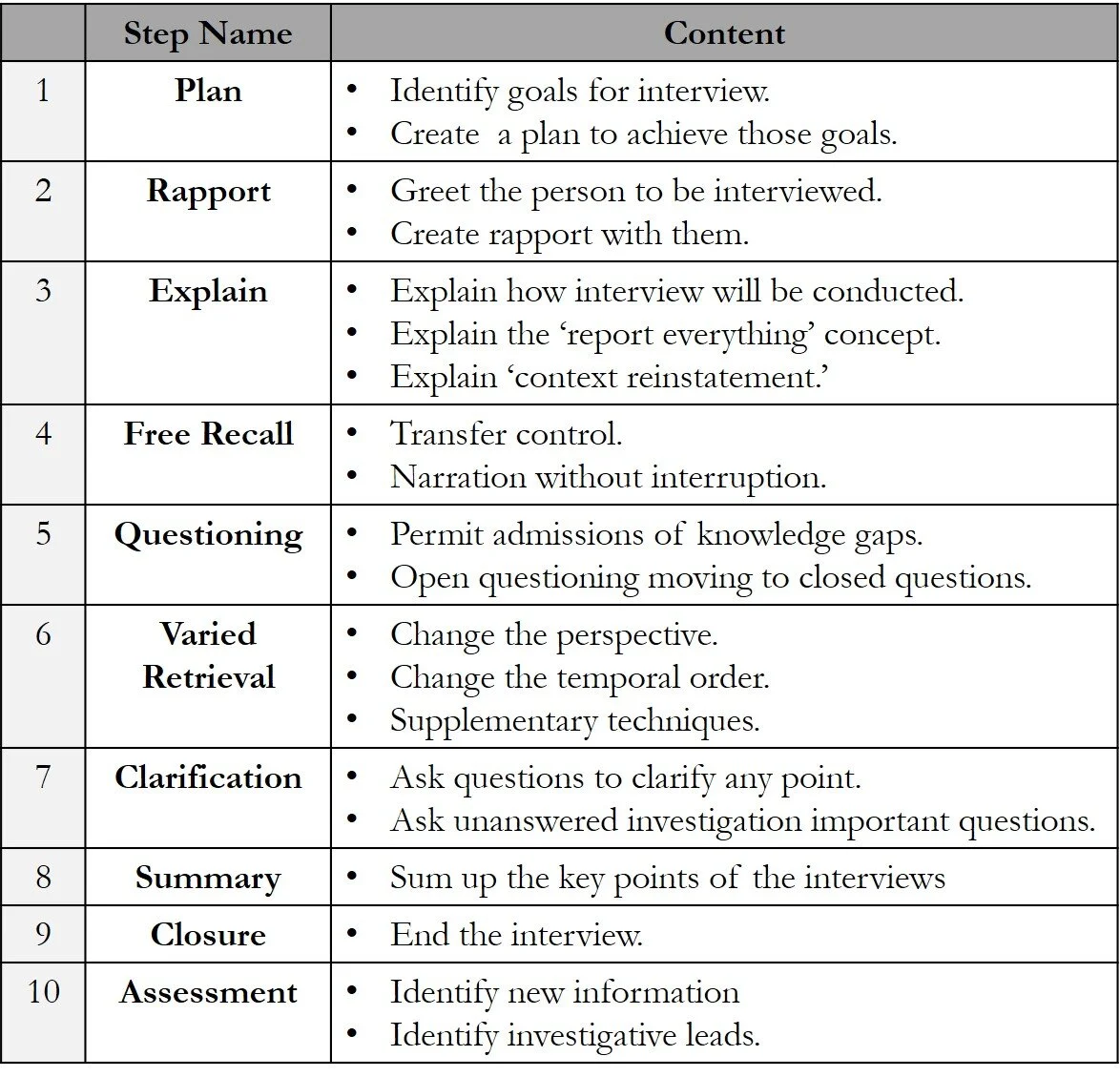
This diagram summarizes a step-by-step structure for delivering a cognitive interview (e.g., rapport building, free recall without interruption, then more focused questioning and varied retrieval). It helps you see how the four memory techniques sit inside a broader interviewing process designed to maximize recall while minimizing distortion. Source
It is usually delivered in a careful, supportive style that helps the witness concentrate.
Important features of the process include:
building rapport so the witness feels comfortable
reducing distractions
allowing the witness to speak freely
avoiding interruption
using open-ended questions
following the witness’s own words rather than imposing assumptions
This matters because witnesses often remember more when they feel relaxed and in control. A rushed or highly leading interview can block recall or introduce inaccuracy.
Evidence for effectiveness
Research generally suggests that the cognitive interview is effective at increasing the amount of correct information recalled. Studies have found that trained interviewers using cognitive interview techniques often obtain more accurate details than interviewers using standard methods.
This is a major strength because the technique has clear practical value in real police work. It applies psychological theory directly to an important legal setting.
Some research also suggests that not all parts of the cognitive interview are equally useful. For example:
report everything
context reinstatement
often seem especially effective, while some other elements may be less consistently helpful.
Limitations in practice
Although the cognitive interview can improve eyewitness recall, it is not perfect.
Some practical limitations are:
it can be time-consuming
police officers need proper training
some parts may be difficult for certain witnesses to use
more information is not always the same as only accurate information
The technique may therefore be most effective when interviewers are skilled and selective in how they apply it. In real investigations, time pressures and varying witness abilities may reduce how fully it can be used.
Exam focus points
When revising the cognitive interview, make sure you can explain:
its aim: to improve the accuracy of eyewitness testimony
its basis in retrieval cues
the four main techniques
why each technique may help memory retrieval
why the method is useful in applied settings
why effectiveness may depend on training and careful use
Practice Questions
Identify two techniques used in the cognitive interview. (2 marks)
1 mark for each correct technique identified, up to 2 marks.
Acceptable answers include:
report everything
reinstate the context
recall in reverse order / different order
change perspective
Outline and explain how the cognitive interview can improve the accuracy of eyewitness testimony. (6 marks)
1 mark each for relevant knowledge point, up to 6 marks.
Possible content:
The cognitive interview is a structured method used with eyewitnesses.
It aims to improve accurate recall by using retrieval cues.
Report everything encourages witnesses to include small details that may trigger other memories.
Context reinstatement helps by mentally recreating the original scene and internal state.
Reverse order reduces reliance on expectations or a rehearsed story.
Change perspective may provide a different retrieval route.
Open-ended, non-leading questioning reduces interviewer influence.
Credit explanation of how these features can increase accurate recall rather than simple description alone.
FAQ
No. In real policing, officers may use only parts of it rather than the full method.
This can happen because:
interviews are sometimes brief
officers may not have advanced training
the witness may be tired, distressed, or very young
the situation may require urgent fact-finding first
So, the cognitive interview is important, but actual use can vary a lot.
The enhanced cognitive interview keeps the core memory techniques but adds stronger communication and social elements.
These can include:
building rapport
reducing witness anxiety
transferring control of the interview to the witness
using questions in a more witness-friendly way
The enhanced version was designed because memory retrieval is affected not only by cues, but also by how comfortable and confident the witness feels during recall.
It can help children, but it usually needs to be adapted carefully.
Important issues include:
simpler language
shorter interviews
avoiding overcomplicated instructions
checking that the child understands what is being asked
Some techniques, especially change perspective, may be harder for younger children to use accurately. Skilled interviewing is especially important so that the child is supported without being led.
Some officers are cautious because it can blur the line between memory and imagination.
If the witness starts to guess what another person saw, the account may become less reliable. That does not mean the technique is always wrong, but it requires careful instructions.
Interviewers usually need to emphasize:
do not invent details
report only what genuinely comes to mind
say when you are unsure
Yes, that can happen. When witnesses are encouraged to say more, the total amount of recall often increases, but some incorrect details may increase too.
This is why investigators should not assume that every extra detail is true. Instead, they should:
compare accounts with other evidence
note confidence carefully
avoid treating quantity as proof of accuracy
The main value of the cognitive interview is that it often improves useful recall overall, especially when well conducted.