AQA Syllabus focus:
'Explanations for forgetting, including retrieval failure due to absence of cues.'
Retrieval failure explains forgetting as a problem of access rather than loss.
A memory may still exist in long-term memory, but without the right cue, it cannot be brought into conscious awareness.
Retrieval failure and cue-dependent forgetting
Core idea
Retrieval failure is an explanation of forgetting that focuses on problems getting information out of memory.
Retrieval failure is forgetting that occurs because a memory cannot be accessed at the time of recall, usually because the right cue is absent.
This explanation assumes that the memory has been stored, but recall depends on whether the person has the correct trigger. Because of this, retrieval failure is often called cue-dependent forgetting. The memory is available, but it is not accessible.
A cue is any stimulus that helps a person retrieve a memory.
Cue is a stimulus linked to a memory at encoding that helps bring that memory back at recall.
Cues can be:
External, such as the place where learning happened
Internal, such as a person’s emotional or physical state
Meaningful, such as category labels or related ideas
The key point is that forgetting happens when these cues are not present at retrieval.
The encoding specificity principle
The main idea behind retrieval failure comes from Tulving’s encoding specificity principle. This states that recall is most effective when the cues present at the time of learning are also present at the time of retrieval. In other words, information is encoded together with aspects of the situation in which it was learned.
This means:
A cue must be present when the memory is formed
The same cue must be available later at recall
The more closely the retrieval situation matches the original learning situation, the more likely recall becomes
Not every cue is useful. A cue only works if it was encoded with the memory in the first place. For example, if a student learned material while feeling relaxed in a quiet room, those conditions may later help retrieval. If recall takes place in a very different setting, forgetting may occur because those original cues are missing.
The encoding specificity principle therefore explains why forgetting can be highly dependent on the situation. It also suggests that poor recall does not always mean the memory has been lost.
Types of cue-dependent forgetting
Context-dependent forgetting
Context-dependent forgetting happens when the external environment at recall is different from the environment present during learning. The physical setting acts as a cue.
A well-known study by Godden and Baddeley used deep-sea divers. Participants learned lists of words either underwater or on land. Recall was better when learning and recall took place in the same context.
Divers who learned underwater remembered more underwater, and those who learned on land remembered more on land.
This supports retrieval failure because:
The words had been stored
Recall changed depending on whether the original context was reinstated
Forgetting occurred when the environmental cues were absent
The study shows that context can become attached to a memory and later help retrieval.
State-dependent forgetting
State-dependent forgetting happens when the person’s internal state at recall differs from their internal state at the time of learning. Internal state can include factors such as mood, level of alertness, tiredness, or being under the influence of a drug.
Research by Carter and Cassaday supports this idea. Participants learned and recalled lists of words either after taking an antihistamine or without it. Antihistamines created a slightly drowsy state. Recall was worse when the internal state at learning and recall did not match.
This suggests that:
Internal states can act as retrieval cues
Forgetting is more likely when these cues change
Memory can improve when the original state is recreated
State-dependent forgetting is especially important because internal cues are less obvious than context cues, but they may still strongly affect recall.
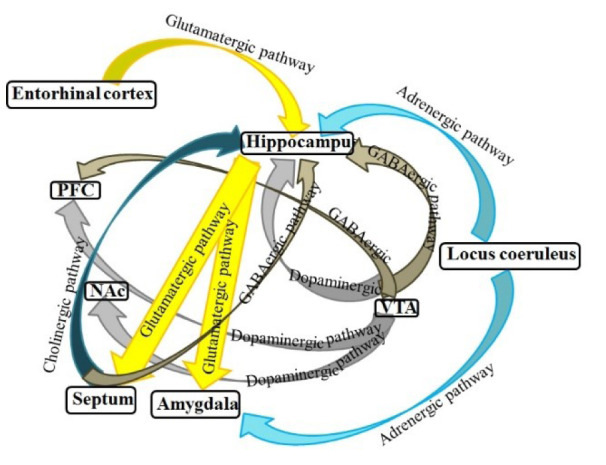
Labeled schematic figure from a review on state-dependent memory, illustrating how changes in an organism’s internal state (e.g., drug-induced state) can gate later retrieval. The figure helps students connect the A-Level idea of ‘internal state as a cue’ to how state manipulations are studied experimentally. Use it as a conceptual visual for why recall tends to improve when learning and testing states match. Source
Research support for retrieval failure
Another important study is Tulving and Pearlstone. Participants learned lists of words arranged into categories. One group used free recall, while another group received category names as cues. The cued-recall group remembered significantly more words.
This finding is important because it suggests that the words were still in memory even when participants could not produce them on their own. When a suitable cue was provided, recall improved. That is strong evidence that some forgetting is due to retrieval failure rather than complete loss of the memory trace.
Together, studies on category cues, environmental context, and internal state all support the same general explanation: recall depends heavily on the presence of appropriate cues.
Evaluation of retrieval failure
Retrieval failure has strong research support from both laboratory studies and real-world style studies. Tulving and Pearlstone showed the effect of cues under controlled conditions, while Godden and Baddeley demonstrated it in a more natural setting. This combination increases confidence in the explanation.
However, the effect of context cues is not always large in everyday life. Many real-world environments are not as different as underwater and on land, so context changes may have only a limited effect on ordinary forgetting.
A further limitation is that retrieval failure cannot explain all forgetting. Sometimes people forget because the material was never encoded well enough in the first place, so there is little or nothing to retrieve. This means cue-dependent forgetting is one explanation, but not the only reason memory fails.
Even so, retrieval failure is useful because it shows that forgetting is often about access. A person may appear to have forgotten, but the memory may still be there, waiting for the right cue.
Practice Questions
Outline what is meant by retrieval failure due to absence of cues. (2 marks)
1 mark for stating that forgetting occurs because the memory cannot be accessed or recalled.
1 mark for stating that the appropriate cue present at encoding is absent at retrieval.
Discuss retrieval failure due to absence of cues as an explanation for forgetting. (6 marks)
AO1 Award up to 3 marks for knowledge and understanding:
Retrieval failure is cue-dependent forgetting.
The memory may still be stored but cannot be accessed without the correct cue.
Reference to the encoding specificity principle.
Description of context-dependent and/or state-dependent forgetting.
Relevant research such as Tulving and Pearlstone, Godden and Baddeley, or Carter and Cassaday.
AO3 Award up to 3 marks for evaluation/discussion:
Research support from studies showing better recall when cues are reinstated.
Real-world relevance because forgetting can depend on surroundings or internal state.
Limitation that context effects may be small in everyday situations.
Limitation that some forgetting may be due to poor encoding rather than missing cues.
FAQ
Recognition tests give the person cues that point toward the stored memory, while recall tasks require the person to generate the memory with much less support.
This means a person may fail to recall a name, fact, or event independently but immediately recognize it when they see options, hear part of it, or revisit a related situation.
Cue overload happens when one cue is linked to too many different memories.
If a cue is not distinctive, it becomes less useful because it activates several possible memories at once. For example:
a common classroom
a familiar smell
a repeated type of task
Distinctive cues tend to work better because they narrow retrieval to one specific memory.
Yes. Sensory information can become strongly linked to a memory during encoding.
Smells are often especially powerful because they are vivid and unusual, which can make them distinctive cues. Music and sounds can also help if they were present when learning happened.
The cue works best when it was actually encoded with the original memory, not just added later.
No. Retrieval failure suggests the memory is currently inaccessible, but it does not prove it will always remain stored.
A memory may:
become accessible again with a cue
weaken over time
be partly reconstructed rather than perfectly recovered
So retrieval failure explains one reason for forgetting, but it does not guarantee permanent storage of every inaccessible memory.
Students can improve retrieval by building multiple cues into learning rather than depending on one setting or one state.
Helpful strategies include:
revising in more than one location
using headings, keywords, and category labels
practicing retrieval at different times of day
linking material to images or distinctive phrases
Using several cues makes recall less dependent on a single context or state.