AQA Syllabus focus:
'Explanations for forgetting, including proactive and retroactive interference.'
Interference theory explains forgetting as the result of competition between memories. For AQA, you need to know the two forms of interference, how they differ, and the evidence supporting this explanation.
Interference and forgetting
The key idea is interference.
A theory of forgetting in which one memory disrupts the recall of another memory.
Interference theory argues that forgetting happens because memories compete with each other. This is especially likely when two memories are similar, because they share features and can easily become confused. In this view, forgetting is not necessarily caused by a memory fading away over time. Instead, the target memory becomes harder to recall because another memory gets in the way. Interference is most likely when a person has learned several pieces of related information, such as similar facts, names, or lists.
Proactive interference
One form of interference is proactive interference.
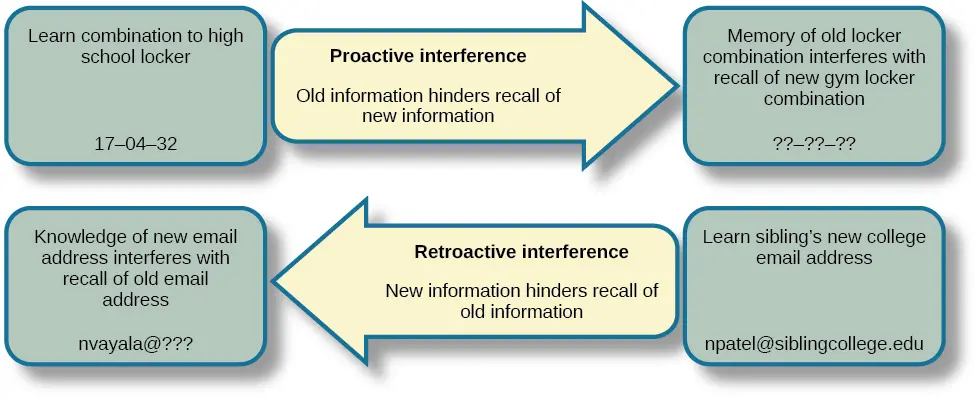
This diagram contrasts the direction of interference effects. In proactive interference, earlier learning disrupts recall of later learning; in retroactive interference, later learning disrupts recall of earlier learning. The arrows make the temporal direction of disruption explicit, which helps avoid confusing the two terms. Source
Forgetting that occurs when older learning disrupts the recall of newer information.
With proactive interference, an existing memory makes it difficult to remember something learned later. For example, an old password may keep coming to mind when you try to remember a new one. The earlier learning has had more time to become established, so it intrudes during recall. This means previous knowledge can sometimes be a disadvantage when new material is very similar to what was learned before. In memory experiments, proactive interference often becomes stronger as the amount of earlier learning increases.
Retroactive interference
The other form is retroactive interference.
With retroactive interference, recently learned information affects memory for material learned earlier. A new phone number may make an old phone number harder to remember. Here, the later memory competes with the earlier one and may be recalled instead. The key point is that forgetting depends on what has been learned after the original memory, not simply on how much time has passed. This is why interference theory challenges the idea that time alone explains forgetting.
When interference is most likely
Interference does not happen equally in all situations. Some conditions make it more likely:
Similarity of material: the more alike two memories are, the more they are likely to interfere.
Repeated learning of related information: several versions of similar material create more competition.
Frequent updating: if information changes often, older and newer versions can clash.
Large amounts of learning: the more material a person has to store, the greater the chance that some of it will overlap.
This helps explain why interference is common in academic settings. Students often study related topics in the same subject, and those memories may compete if they are not clearly separated.
Research support
A well-known study by McGeoch and McDonald (1931) supports interference theory. Participants learned a list of words and then learned a second list. The second list varied in how similar it was to the first. Recall of the original list was worst when the second list contained similar material, especially synonyms. Recall was much better when the second list was very different, such as numbers or nonsense syllables. This supports interference because the amount of forgetting depended on similarity, not just on the passage of time.
Evidence for proactive interference comes from Underwood (1957).
He found that participants in memory experiments often performed worse when they had already learned more lists on earlier occasions. In other words, old learning appeared to build up and make new learning harder to recall. This finding is important because it shows that proactive interference can accumulate over time as similar information increases.
There is also support from a more natural setting. Baddeley and Hitch (1977) studied rugby players’ memory for teams they had played earlier in the season. Players’ recall was linked more closely to the number of intervening games than to the amount of time that had passed. This suggests that forgetting occurred because later games interfered with memory for earlier ones. The study is useful because it shows interference can operate in everyday life, not only in laboratory tasks.
Evaluation of interference theory
A major strength of interference theory is that it has been tested in highly controlled studies. Researchers can manipulate the order of learning and the similarity of the material, which makes it easier to establish cause and effect. When forgetting increases after similar material is introduced, this gives strong support to the explanation.
However, much of the evidence comes from artificial tasks, such as memorizing word lists. These tasks may not reflect the complexity of real-life memory, where information is usually meaningful, emotionally important, and linked to wider knowledge. This means interference may be easier to demonstrate in the lab than in everyday situations.
On the other hand, the rugby study suggests that interference has real-world relevance as well. It shows that the explanation is not limited to meaningless lists and can help explain forgetting in natural contexts where many similar memories build up.
A further limitation is that interference does not explain all forgetting equally well. It is strongest when memories are similar and when there are clear competing pieces of information. For distinctive or unusual experiences, interference is likely to be less convincing as an explanation, so it is best seen as a strong but not complete account of forgetting.
Practice Questions
Briefly distinguish between proactive interference and retroactive interference. (2 marks)
1 mark for stating that proactive interference is when older information disrupts newer information.
1 mark for stating that retroactive interference is when newer information disrupts older information.
Outline and evaluate interference as an explanation for forgetting. (6 marks)
AO1: 3 marks
1 mark for describing interference as forgetting caused by one memory competing with another.
1 mark for outlining proactive interference.
1 mark for outlining retroactive interference and/or stating that interference is stronger when material is similar.
AO3: 3 marks
1 mark for identifying relevant supporting evidence, such as McGeoch and McDonald, Underwood, or Baddeley and Hitch.
1 mark for explaining why that evidence supports interference.
1 mark for a limitation, such as the use of artificial materials or the fact that interference explains similar memories better than unique ones.
FAQ
If you study and then go to sleep soon afterward, fewer new memories are added immediately after learning. That can reduce retroactive interference because there is less competing material.
Sleep does not guarantee perfect memory, but it may give recently learned information a quieter period with less competition from new learning.
Yes. Interference can happen whenever two responses are similar enough to compete, not just with word lists or facts.
Examples include:
mixing up keyboard shortcuts
confusing two dance routines
using an old sports technique when trying to apply a new one
taking a familiar route by mistake instead of a newer one
This is the improvement in memory that appears when the type of material changes after several similar learning trials. For example, recall may improve if a person switches from several lists of animals to a list of jobs.
Psychologists use this effect to show that similarity matters. When the category changes, the buildup of proactive interference drops.
Recall requires a person to produce the answer with little or no support, so competing memories have more chance to intrude.
Recognition provides prompts or options, which can help separate the correct memory from similar alternatives. Because of that, interference often looks stronger on free-recall tasks than on recognition tasks.
Students can make similar material more distinct so it is less likely to compete.
Useful methods include:
separating very similar topics into different study sessions
comparing similar ideas directly so differences stand out
using different examples, colors, or labels for each topic
testing recall soon after learning to catch confusion early
These methods reduce overlap, which can lower interference.