AQA Syllabus focus:
'Explanations for conformity, including informational social influence and normative social influence.'
Conformity happens for different reasons. Sometimes people look to others for guidance about reality, while at other times they fit in to gain approval and avoid social rejection.
Understanding explanations for conformity
Psychologists explain conformity by focusing on the motives behind behavior change in groups. A person may agree with others because the group seems to know the correct answer, or because belonging to the group matters. These explanations help show why people often adjust their judgments, opinions, or actions even when there is no direct force or command.
Informational social influence
Informational social influence: Conformity that happens because a person wants to be correct and uses other people as a source of information about reality.
Informational social influence (ISI) is based on the need for accuracy.
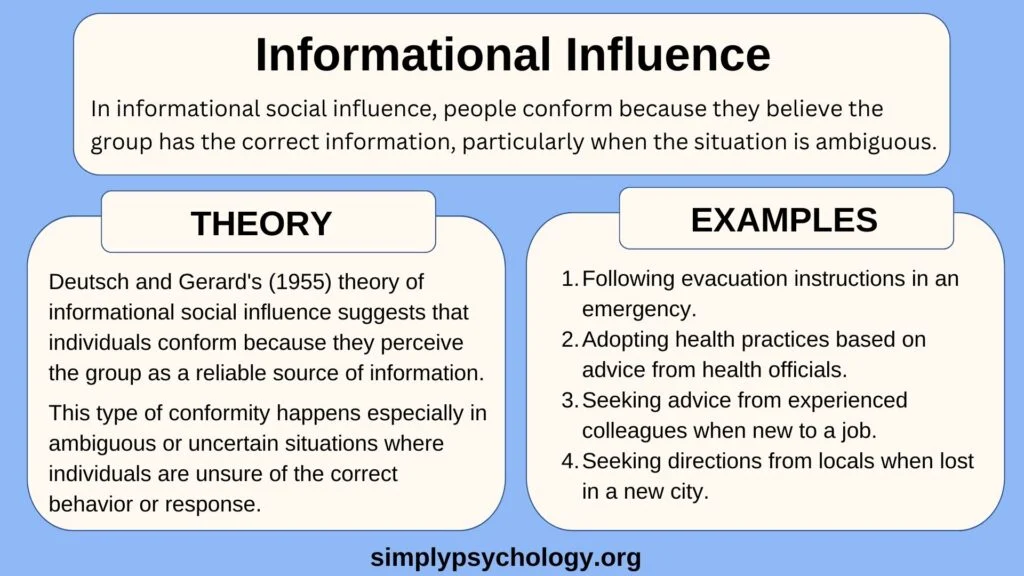
Summary diagram defining informational social influence as conformity driven by the desire to be correct under uncertainty. The examples emphasize ambiguous or unfamiliar situations where other people are treated as evidence about reality, which aligns with the notes’ description of ISI as a cognitive (judgment-based) explanation. Source
When a situation is unclear, unfamiliar, or difficult, people may assume that others understand it better than they do. Instead of relying only on their own judgment, they look to the group for clues about what is true or what the right response should be.
This form of conformity is especially likely when the individual feels uncertain. If a task has no obvious answer, other people become an important guide. The person may think, “They probably know something I do not.” In this way, the group is treated as a useful source of evidence.
ISI is more likely in situations such as:
Ambiguous situations, where the correct answer is not obvious
Novel situations, where the person has little previous experience
Crisis situations, where quick decisions are needed
Situations where others seem knowledgeable, expert, or more confident
A key feature of ISI is that the person may come to believe the group is genuinely correct. The influence is not just about appearance or politeness. Instead, the individual may accept the group’s view as accurate and use it as the basis for future behavior.
Because ISI depends on perceived information, it can happen even without strong social pressure. A person does not have to fear rejection in order to conform in this way. It is enough that the group seems to offer a better understanding of reality. For that reason, ISI is often described as a cognitive explanation: it is linked to thinking, judgment, and decision-making.
However, ISI does not guarantee that the group is actually right. People may still conform to inaccurate opinions if they mistakenly believe the majority has better information. Even so, from the individual’s point of view, conformity feels reasonable because it seems to increase the chance of being correct.
Normative social influence
Normative social influence: Conformity that happens because a person wants to be liked, accepted, or approved of, and wants to avoid rejection or disapproval.
Normative social influence (NSI) is based on the need for social approval.
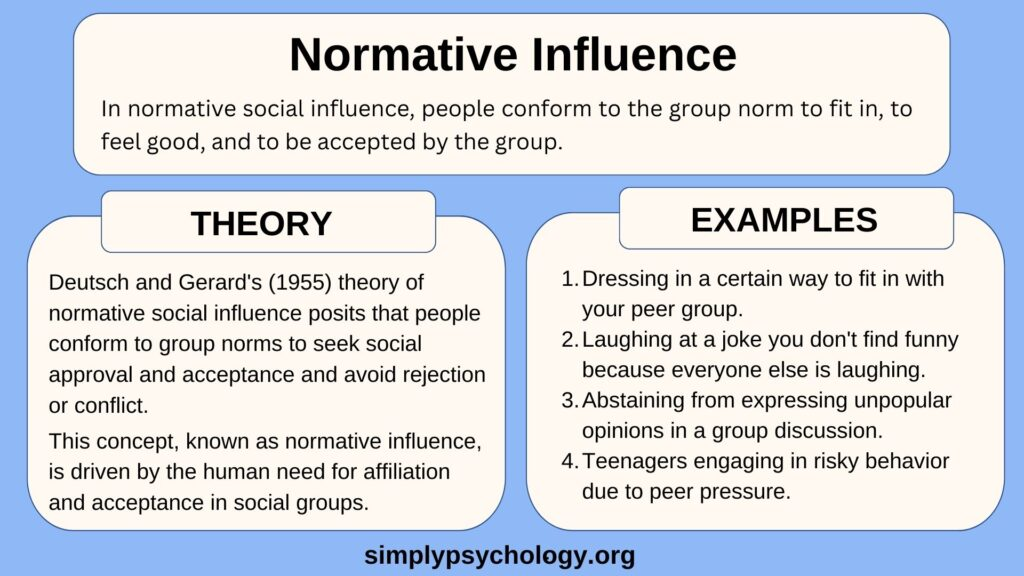
Summary diagram defining normative social influence as conformity motivated by acceptance and avoidance of rejection. The examples illustrate how people may align their public responses with group norms even when their private beliefs do not change, matching the notes’ emphasis on outward compliance. Source
People are strongly motivated to belong to groups, maintain friendships, and avoid conflict. As a result, they may go along with the group’s expectations even when they do not truly agree.
With NSI, conformity is often about fitting in. The individual recognizes the group’s norms—the accepted ways of behaving or thinking—and adjusts their outward response to match them. This can include agreeing publicly, staying quiet instead of disagreeing, or copying the behavior of others in order to avoid standing out.
NSI is more likely when:
The group is important to the person
The person wants to be accepted or fears being excluded
The response is made in public
There is clear pressure to behave in a socially approved way
A major point about NSI is that behavior may change outwardly without a deep private change in belief. The person may conform to avoid embarrassment, criticism, or isolation, while still thinking differently in private. This makes NSI especially relevant in face-to-face groups, where people are aware of being judged by others.
NSI is often described as an emotional and social explanation.

Diagram of the cards used in Asch’s line-judgment task: a single reference line is matched to one of three comparison lines (A, B, C). In the classic procedure, the task is objectively clear, so conformity is typically explained by normative pressure (publicly going along to avoid standing out) rather than a genuine belief change. Source
The pressure comes from the value people place on relationships, approval, and belonging. In many everyday settings, this is highly powerful. Humans are social beings, so avoiding rejection can be a strong motive for conformity even when the group offers no better information.
Comparing informational and normative social influence
The most important difference between ISI and NSI is the reason for conforming.
With ISI, the main motive is to be correct
With NSI, the main motive is to be accepted
This difference affects how conformity operates. ISI is strongest when reality is uncertain and the person needs guidance. NSI is strongest when social relationships, approval, and group membership are especially important.
The two explanations can also work together. In many real situations, a person may believe that the group probably knows better and also want to avoid looking different. This means conformity is often produced by a combination of informational and normative pressures rather than by only one influence.
Another useful distinction is the likely effect on beliefs. ISI is more likely to produce a genuine shift in what a person thinks is true, because the group has been used as a source of evidence. NSI is more likely to affect what a person says or does in front of others, because the goal is social acceptance.
Both explanations show that conformity is not simply weakness or blind copying. It can come from rational attempts to understand the world, from the normal human need to belong, or from both at once.
Practice Questions
Explain two explanations for conformity: informational social influence and normative social influence. (6 marks)
Award up to 3 marks for informational social influence and up to 3 marks for normative social influence.
Informational social influence:
Conformity happens because the person wants to be correct. (1 mark)
Other people are used as a source of information or guidance. (1 mark)
It is more likely in ambiguous, unfamiliar, difficult, or crisis situations, or when others seem more knowledgeable. (1 mark)
Normative social influence:
Conformity happens because the person wants social approval or acceptance. (1 mark)
The person conforms to avoid rejection, criticism, or exclusion. (1 mark)
It is especially likely in public situations or when the group is important to the person. (1 mark)
Outline what is meant by normative social influence. (2 marks)
Conformity occurs because a person wants to be liked, accepted, or approved of by others. (1 mark)
The person conforms to avoid rejection, disapproval, or standing out from the group. (1 mark)
FAQ
When people feel anonymous, they are less exposed to immediate judgment from others.
That can reduce the pressure to fit in for approval, because:
embarrassment is less likely
rejection feels less direct
public image matters less
Anonymity does not remove all conformity, but it can weaken the social costs of disagreement.
Yes. ISI can be highly useful when other people genuinely know more than you do.
For example, it may help when:
learning unfamiliar social rules
responding to emergencies
making decisions in areas where experts have better knowledge
In these cases, following others can improve accuracy rather than simply produce error.
Adolescence is a period when peer acceptance often becomes very important.
As a result:
social approval may feel especially rewarding
exclusion may feel especially threatening
visible differences from the group may be harder to tolerate
This can make fitting in a stronger motive than it is for some adults.
Social media can strengthen both forms.
For normative social influence, visible likes, shares, and comments can increase pressure to appear acceptable.
For informational social influence, high follower counts, repeated opinions, or viral content can make people assume that popular views are accurate.
Online environments can blur the line between “popular” and “correct.”
Yes. Someone might not care much about approval, so normative social influence is weak, but still rely on others for guidance when unsure, so informational social influence remains strong.
The reverse can also happen. A person may feel confident in their own judgment but still go along publicly to avoid awkwardness.
This shows that the two explanations are separate, even though they often occur together.