Differentiation enables students to analyze how functions behave dynamically. This section specifically explores the sophisticated techniques of parametric and implicit differentiation, which are vital for examining more complex functions and equations.
Parametric Equations
Parametric equations are a set of functions where and are both described in terms of a third variable, often denoted as . This method is particularly useful for characterizing curves that do not lend themselves to simple functional relationships.
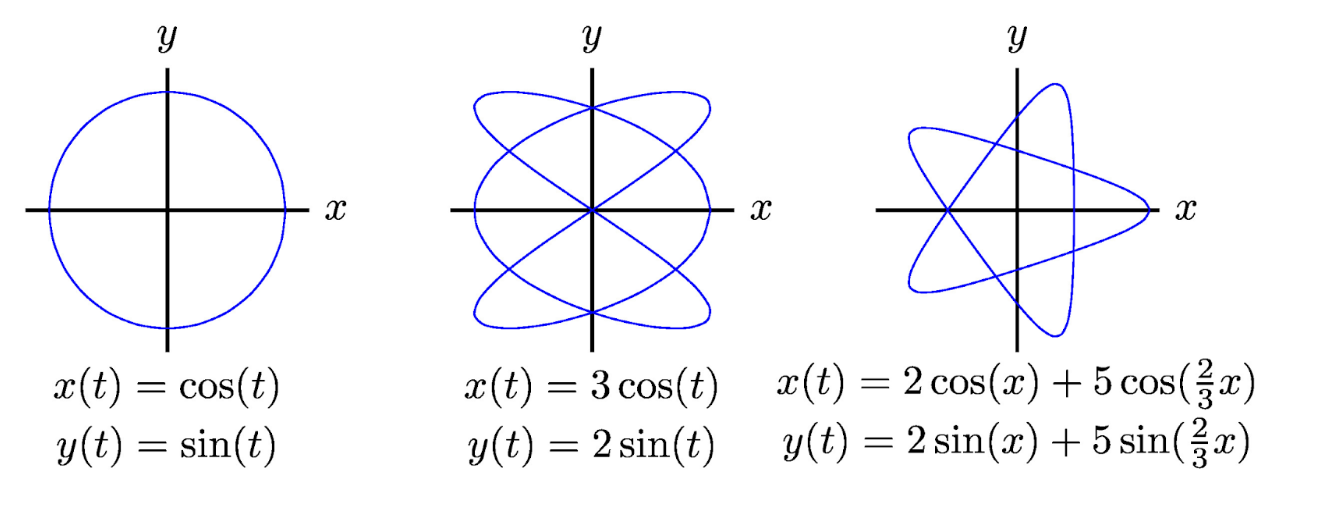
Image courtesy of Mathbooks
For parametric equations where and are functions of :
1. Differentiate and with respect to .
2. Calculate as
Example:
Differentiate and :
Solution:
Thus,
Simplified:
Implicit Functions
Implicit functions are those in which and are intermingled within the same equation. They often describe complex shapes and relationships that are not easily separated into distinct functions.
Implicit differentiation for equations with and mixed:
1. Treat y as a function of .
2. Differentiate the whole equation with respect to .
3. Solve for .
Example:
Differentiate the implicit function $x^2 + y^2 = xy + 7 x \frac{dy}{dx}xxy2x + 2yy' = y + xy'y'\frac{dy}{dx}y'y' = y - 2x$