Contents
Absolute value, often symbolised as |x|, is a fundamental concept in algebra. It represents the distance of a number from zero on the number line, regardless of the direction. This topic explores the properties and applications of absolute value, a crucial tool in various mathematical contexts.
The Modulus Function
- Definition: The modulus of a number, denoted as |x|, represents its absolute value. It gives the non-negative distance of the number from the origin on the number line.
- Properties:
- Multiplication: For any two real numbers and , .
- Division: For non-zero , .
- Square: , showing that the square of a number is always non-negative.
- Equality: if and only if .
- Square Roots: , as square roots yield non-negative values.
Graphing Absolute Value Functions
- General Form: The graph of features a V-shape and is symmetrical about the vertex. This function never produces negative values.
- Reflection Principle: In graphical representation, any part of the function below the x-axis is reflected above it, maintaining the same distance from the axis.
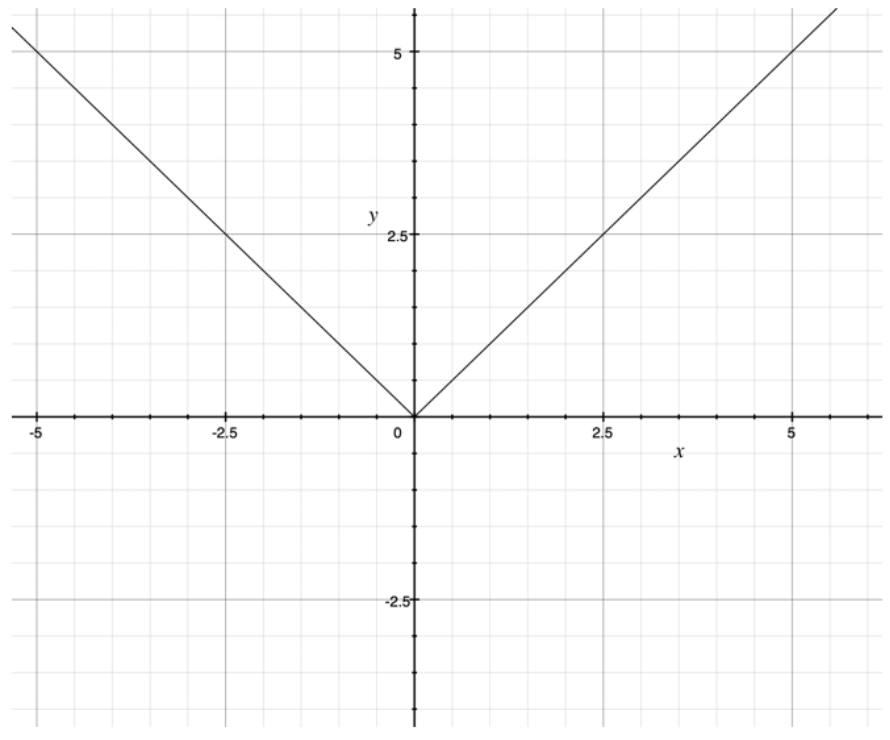
Figure: An example of a modulus function graph, illustrating the V-shape and reflection principle.
Solving Equations and Inequalities
- Equations: To solve , set up two equations: and .
- Inequalities: For , the solution is . This represents a range of values where the distance from is less than .
Examples
Example 1:
Equation: Solve .
Solution:
It involves two scenarios: and , leading to and .
Example 2:
Inequality: Solve .
Solution:
The solution range is from to , yielding .