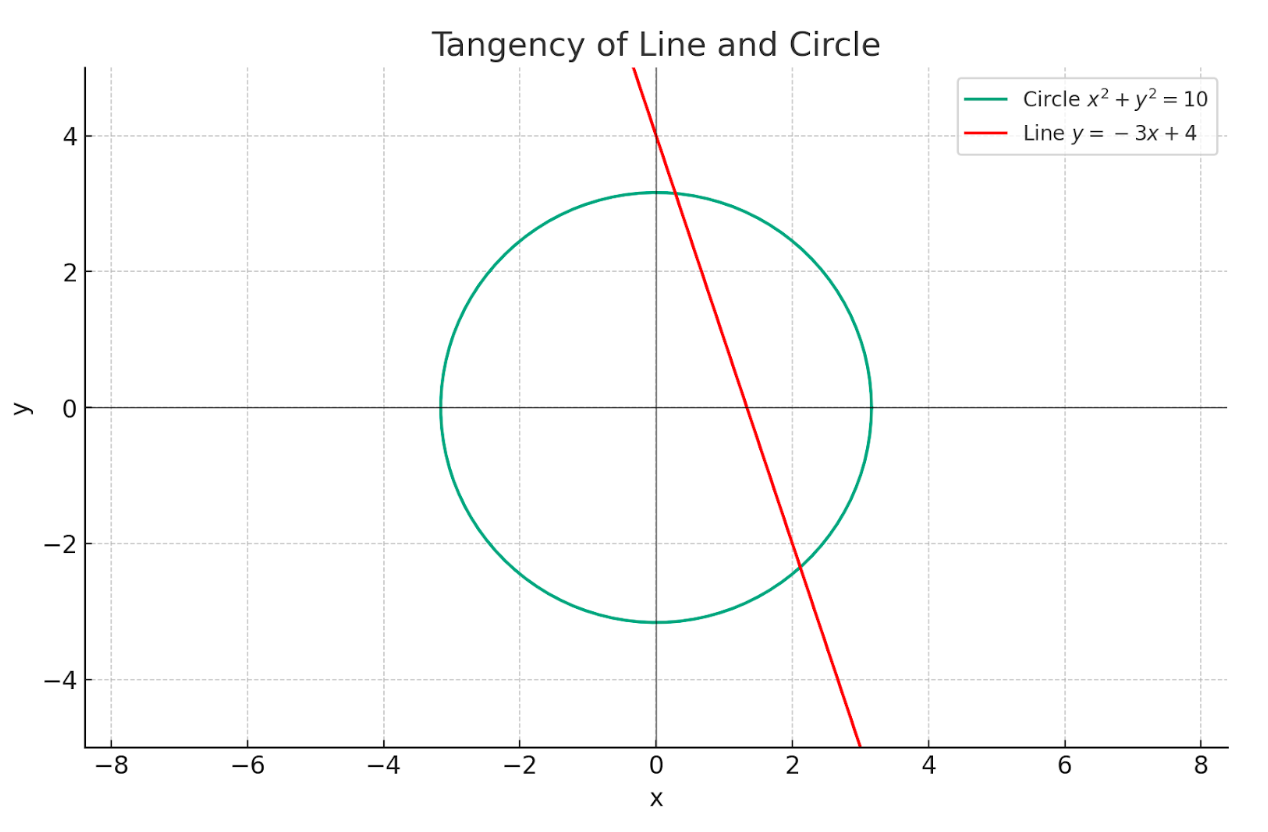
In the realm of Pure Mathematics, particularly within coordinate geometry, the concept of graph intersections is pivotal. This section aims to provide a comprehensive understanding of the relationship between graph intersection points and the solutions of equations. It explores the conditions under which a line intersects, touches, or does not meet a curve, employing both algebraic methods and graphical illustrations.
Intersection Points and Equation Solutions
- Intersection Points: These are the points where two or more graphs meet. They are crucial as they represent the solutions to the system of equations depicted by the graphs.
- Graphical Solution Method: To find solutions to a system of equations, plot each equation on the same set of axes. The coordinates of the intersection points are the solutions.
Conditions for Intersection
- Lines and Curves: A line can intersect a curve at no point, exactly one point (tangent), or multiple points.
- Determining Intersection Conditions: Algebraically solving the equations simultaneously helps determine the number of intersection points.
Lines Intersecting Curves
- Tangent Lines: A tangent line touches a curve at exactly one point without crossing it. The slope of the tangent at any point on a curve equals the derivative of the curve's equation at that point.
- Normal Lines: A normal line is perpendicular to a tangent at the point of tangency.
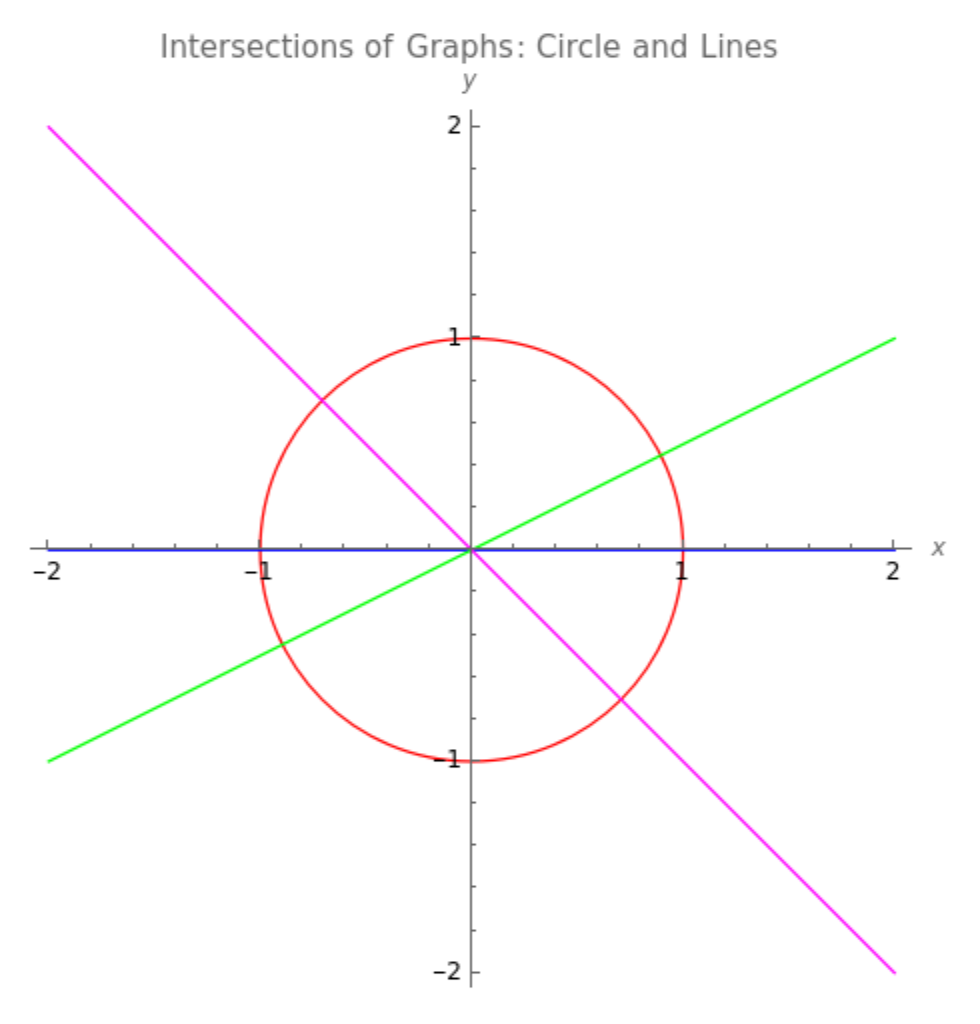
Algebraic Methods for Finding Intersections
Simultaneous Equations: Intersection points are found by solving the equations simultaneously.
Example:
Determine the intersection points of the line and the circle .
Solution:
- Solving for : The solutions are and .
- Finding -Coordinates:
- For , .
- For , .
- Intersection Points:
- Point 1:
- Point 2:
These points are where the line and the circle intersect.
Practical Problems
Problem 1:
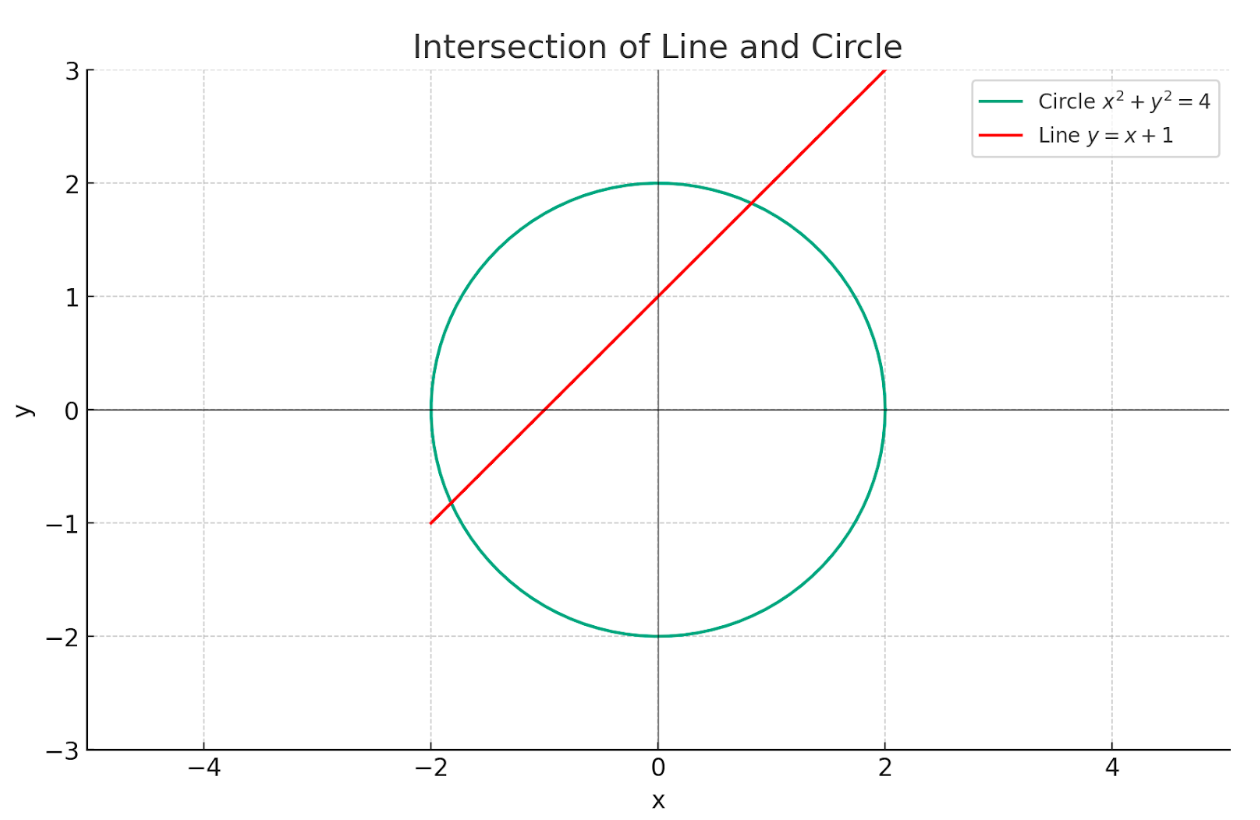
Find the intersection points of the line and the circle .
Solution:
1. Combine Equations:
Substituting from the line equation into the circle equation results in .
2. Solve for :
The quadratic equation is solved to find values:
- and .
3. Find Values:
Corresponding values are calculated as:
- For , .
- For , .
4. Intersection Points:
- Point 1:
- Point 2:
These points are where the given line and circle intersect.
Problem 2:
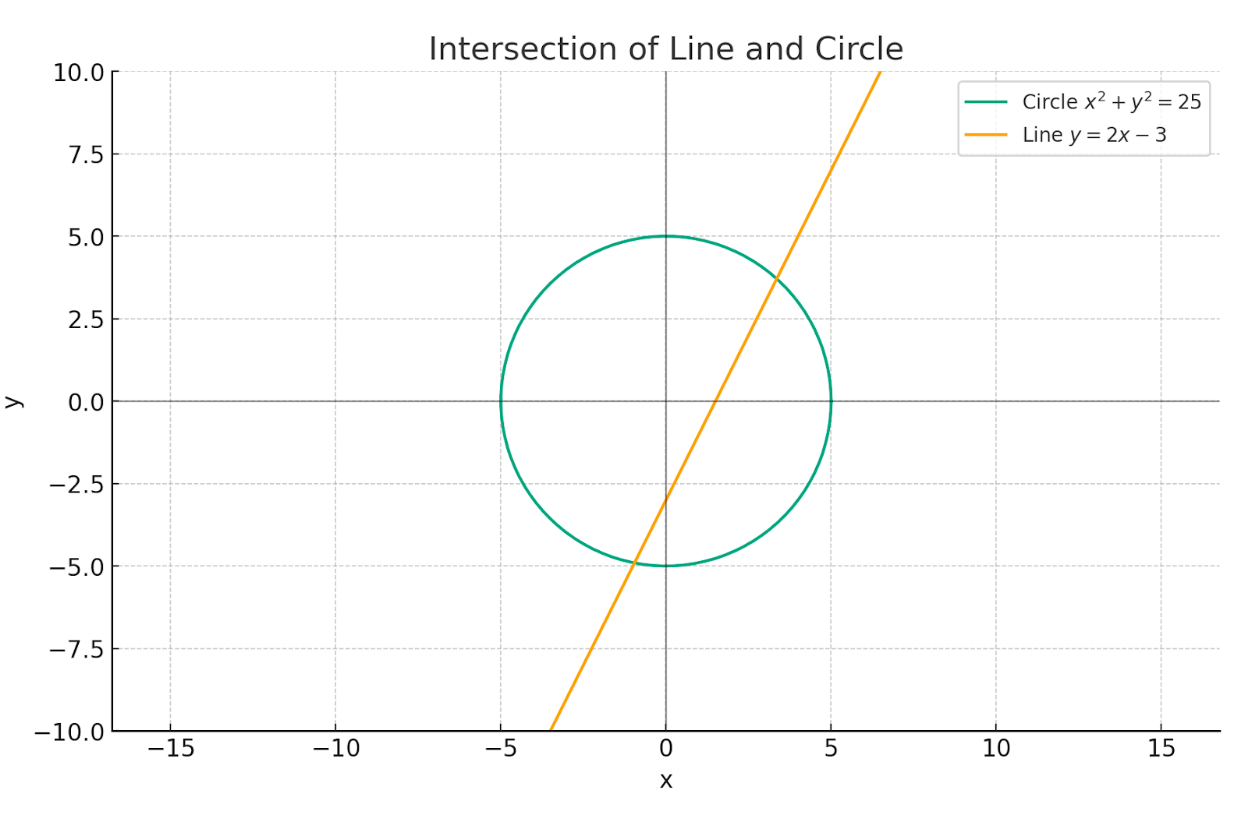
Check if is tangent to .
Solution:
1. Line Equation:
2. Circle Equation:
3. Substitute into Circle Equation:
4. Solve Quadratic Equation for :
5. Check for Tangency: A line is tangent to a circle if the quadratic equation has exactly one solution, which occurs when the discriminant is zero.
Discriminant
Since the discriminant is not zero, the equation has two distinct solutions, indicating two intersection points between the line and the circle.
Conclusion: The line is not tangent to the circle as there are two intersection points.