AQA Syllabus focus:
'The working memory model, including the central executive, phonological loop, visuo-spatial sketchpad and episodic buffer.'
The working memory model explains short-term memory as an active system made of separate but linked parts. It shows how we temporarily hold, manipulate, and combine information during everyday thinking tasks.
Working memory model — a model of short-term memory proposed by Baddeley and Hitch in which immediate memory is divided into different components that process and coordinate information.
Overview
Baddeley and Hitch argued that short-term memory is not a single store. Instead, working memory is a flexible system used for tasks such as reasoning, reading, mental arithmetic, and decision-making. Different types of information can be handled at the same time because different components have different jobs.
The model was developed partly because people can carry out two simple tasks at the same time if they use different kinds of material, but struggle when both tasks compete for the same mental resources.
The original model had three main parts:
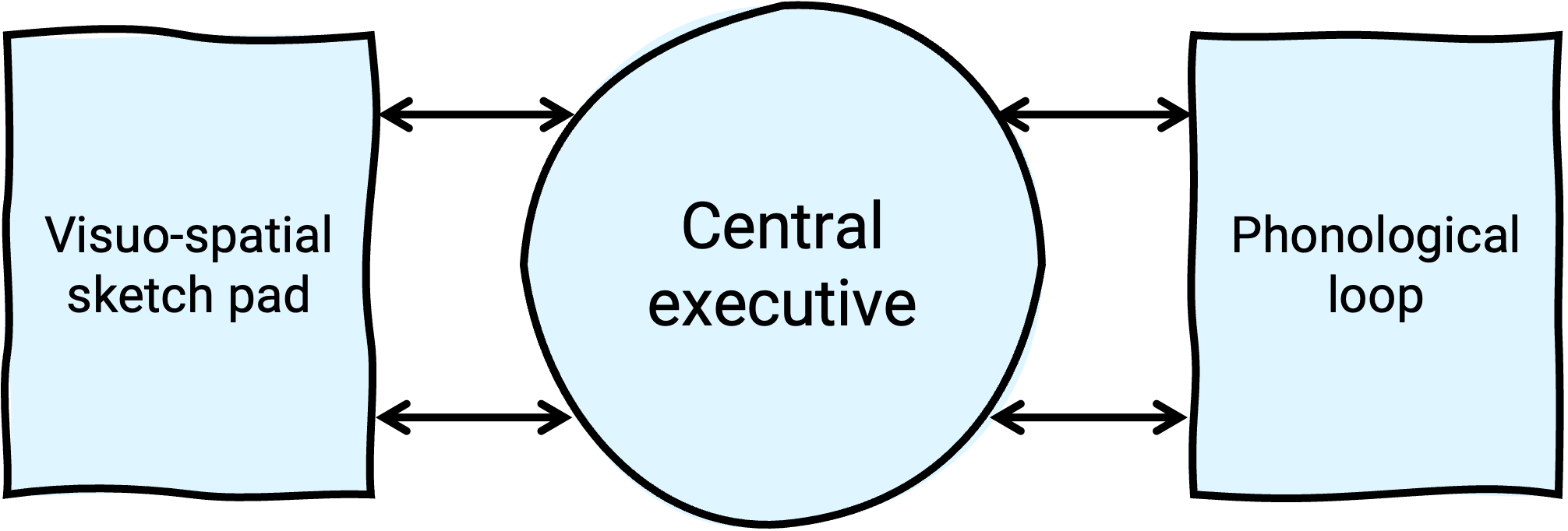
Diagram of the original Baddeley & Hitch working memory model, with the central executive controlling two modality-specific subsystems: the phonological loop and the visuo-spatial sketchpad. It’s useful for contrasting the initial three-part framework with later versions that add the episodic buffer for cross-system integration. Source
the central executive
the phonological loop
the visuo-spatial sketchpad
Baddeley later added a fourth part, the episodic buffer, to explain how information from different sources can be combined into a single, meaningful episode.
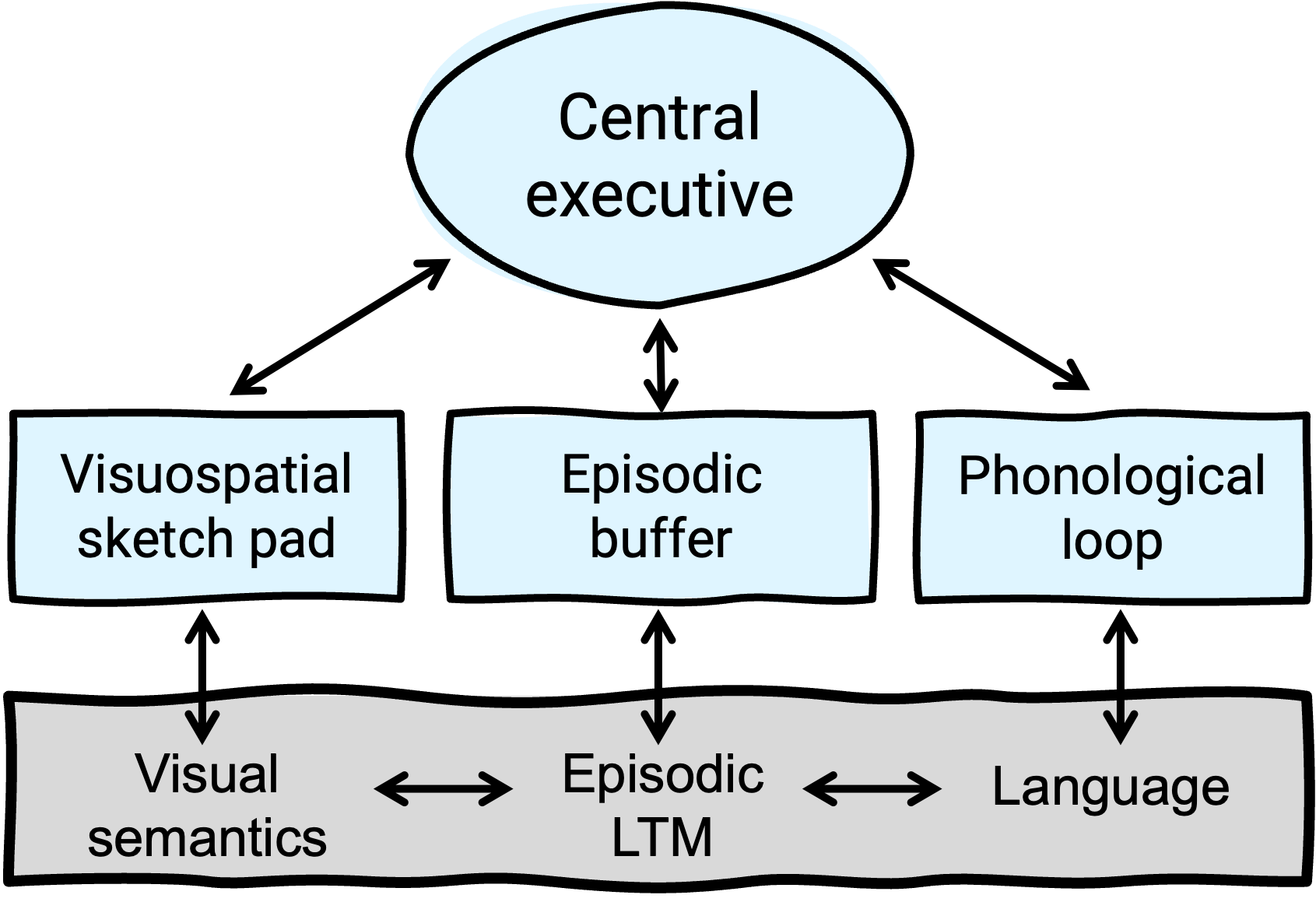
Diagram of Baddeley’s updated working memory model showing the central executive coordinating the phonological loop, visuo-spatial sketchpad, and episodic buffer, with explicit links to long-term memory systems. It helps you visualize the episodic buffer as an interface that binds information across modalities rather than storing only verbal or only visual material. Source
The central executive
Main role
The central executive is the attentional control system of working memory. Rather than storing one type of material itself, it directs attention and allocates processing resources to the other components. It decides which information is focused on and which task should be dealt with first.
Key functions of the central executive include:
focusing attention on relevant information
dividing attention between tasks
switching attention from one task to another
coordinating the activities of the other parts of working memory
It is often described as modality free, meaning it can handle information regardless of whether it is verbal or visual.
Because it controls the system, the central executive is sometimes described as the most important component. However, it is also the least clearly defined. Psychologists often describe what it does by observing how performance changes when people try to carry out more than one demanding task at once.
The phonological loop
Speech-based information
The phonological loop deals with spoken and written material that can be represented in a speech-based form. It helps us keep information in mind for a short time when we are listening, reading, rehearsing, or repeating something to ourselves.
Baddeley divided the phonological loop into two parts:
the phonological store, which briefly holds the sounds of words we hear
the articulatory process, which allows maintenance rehearsal and refreshes the material by silently repeating it
The phonological store is sometimes called the inner ear because it receives and holds sound-based information. The articulatory process is sometimes called the inner voice because it repeats the information and keeps it active.
This part of the model explains why repeating a phone number or a list of words can help us keep it available for a short period. It also explains why speech-based distractions can interfere with verbal tasks.
The visuo-spatial sketchpad
Visual and spatial information
The visuo-spatial sketchpad processes visual details and spatial layout. It is involved when we picture an object, follow a route, judge where things are, or mentally rotate shapes. In simple terms, it lets us hold and work on images in the mind.
Some psychologists suggest that the visuo-spatial sketchpad can itself be divided into:
a visual cache, which stores form and color
an inner scribe, which deals with spatial relationships and movement
This suggested division helps explain why some visual tasks mainly involve appearance, while others depend more on location or movement. The overall idea is that the sketchpad is specialized for mental imagery and spatial processing, rather than speech-based material.
The episodic buffer
Integrating information
The episodic buffer was added to the model later.
Its purpose is to bind information together from different components of working memory and from long-term memory. This means it can combine visual material, verbal material, and stored knowledge into a single, organized representation.
For example, when a person understands a story, they may need to connect the words they are hearing, the images they are forming, and relevant knowledge already stored in long-term memory. The episodic buffer provides a temporary space where this integration can happen.
A key feature of the episodic buffer is that it creates coherent episodes rather than keeping information completely separate. It also helps explain chunking, because separate pieces of information can be grouped into larger, meaningful units. This helped solve a weakness in the original model, which did not fully explain how the different components worked together to produce unified experience.
How the components work together
In most real tasks, the components of working memory do not operate in isolation. The central executive manages attention, the phonological loop handles speech-based material, the visuo-spatial sketchpad handles images and spatial details, and the episodic buffer links these elements into a meaningful whole.
This makes the model especially useful for explaining complex mental activity. For instance, understanding spoken directions while imagining a route involves more than one component at the same time. The working memory model therefore presents short-term memory as active, interactive, and multi-component, rather than as a single, simple store.
Evidence linked to the components
Research supports the idea of separate components. Dual-task studies show that people can often do a verbal task and a visual task together more easily than two tasks that both rely on the same subsystem. This suggests that the phonological loop and visuo-spatial sketchpad are separate parts of working memory.
Evidence also comes from clinical cases. Some patients show poor verbal short-term memory but better visual performance, which would be difficult to explain if short-term memory were only one unitary store. At the same time, the central executive remains harder to test directly, so this part of the model is sometimes criticized for being more difficult to measure precisely.
Practice Questions
Identify two components of the working memory model other than the central executive. (2 marks)
1 mark for each correct component identified, up to 2 marks.
Credit:
phonological loop
visuo-spatial sketchpad
episodic buffer
Outline and explain the role of the central executive and one other component of the working memory model. (6 marks)
Up to 3 marks for the central executive:
controls attention
allocates processing resources
switches or divides attention
coordinates the other components
not mainly a storage system
Up to 3 marks for one other component:
phonological loop: deals with verbal or speech-based information; includes phonological store and articulatory process; rehearsal keeps material active
visuo-spatial sketchpad: deals with visual and spatial information; used for mental images, location, and movement
episodic buffer: integrates information from different components and long-term memory into a single episode
Full marks require accurate detail about both parts named in the answer.
FAQ
They were called slave systems because they were thought to work under the control of the central executive rather than independently directing attention themselves.
Today, some psychologists avoid the term because it sounds outdated and can be misunderstood. The key idea you need is simply that these subsystems carry out specialized processing while the central executive manages overall control.
The word length effect is the finding that people usually recall short words better than long words in immediate memory tasks.
This matters because it supports the idea of an articulatory process. Short words can be silently repeated more quickly, so they are easier to keep active in the phonological loop before they fade.
The original model explained separate verbal and visual systems well, but it was weaker at explaining how information became a single, unified memory.
Baddeley added the episodic buffer to deal with:
combining verbal and visual material
linking working memory to long-term memory
explaining tasks such as immediate recall of meaningful prose, where information seems to be integrated rather than kept separate
Yes, brain imaging suggests some specialization. Verbal working memory is often linked to areas in the left hemisphere, including language-related regions.
Visuo-spatial tasks more often involve right hemisphere occipital and parietal areas, while control processes linked to the central executive are often associated with the prefrontal cortex. These links support the model, but they are not perfectly simple or one-to-one.
Some psychologists think it can. Instead of being one single controller, it may include several executive functions.
Common suggestions include:
inhibition of irrelevant information
shifting attention between tasks
updating working memory contents
This helps explain why the central executive can seem vague: it may actually be a group of related control processes rather than one unitary mechanism.