AQA Syllabus focus:
'The dispositional explanation for obedience: the Authoritarian Personality.'
This explanation argues that obedience can stem from enduring personality traits. It suggests some people are more likely than others to submit to authority because of how their personality developed.
The basic idea
The authoritarian personality is a dispositional explanation for obedience. This means it explains obedient behavior in terms of internal characteristics of the individual, rather than focusing mainly on the immediate social situation.
Dispositional explanation: An explanation that locates the cause of behavior in stable internal features of a person, such as personality traits or attitudes.
The best-known account was developed by Adorno and colleagues, who were interested in why some people showed extreme obedience to authority and hostility toward those seen as weaker or inferior.
Authoritarian personality: A personality type characterized by strong respect for authority, rigid beliefs, obedience to those in power, and hostility toward people of lower status or those who break conventional rules.
According to this view, people with an authoritarian personality are especially likely to obey legitimate authority figures because they value order, discipline, and clear social hierarchies. They tend to see authority as something that should be followed, not questioned. This makes obedience more likely when instructions come from someone viewed as powerful or superior.
Typical characteristics
Adorno argued that the authoritarian personality includes a cluster of related traits:
Submission to authority: a strong tendency to obey and admire people in power
Conventionalism: rigid adherence to traditional values and social rules
Hostility toward inferiors: contempt for people seen as weak, deviant, or lower in status
Preoccupation with status and power: respect for strength and concern with social rank
Rigid thinking: a tendency to think in fixed categories, with little tolerance for ambiguity
Stereotyped beliefs: oversimplified and inflexible judgments about social groups
These traits make obedience more likely because the person already accepts inequality and expects those lower down to obey those above them.
How the personality develops
Adorno believed that the authoritarian personality has its roots in childhood experiences, especially very harsh parenting. This includes parents who are strict, punitive, and demanding, but also emotionally distant.
The theory suggests the child experiences resentment toward these powerful parents but cannot express it openly because the parents are too threatening. Instead, that hostility is repressed and later redirected toward safer targets, such as weaker people or minority groups. At the same time, the child learns that obedience to authority is necessary and desirable.
This process is often described in stages:
The child is raised by strict and controlling parents
The child develops anger and frustration
The child cannot safely challenge the parents
The child identifies with the parents’ values of discipline and authority
The repressed hostility is displaced onto weaker individuals
A lasting personality structure develops that favors obedience and aggression in the “correct” direction
In this account, obedience is not just a temporary response. It becomes part of the person’s habitual way of relating to authority.
Measuring authoritarianism
To investigate this personality type, Adorno and colleagues developed the F-scale, where F stands for fascism.
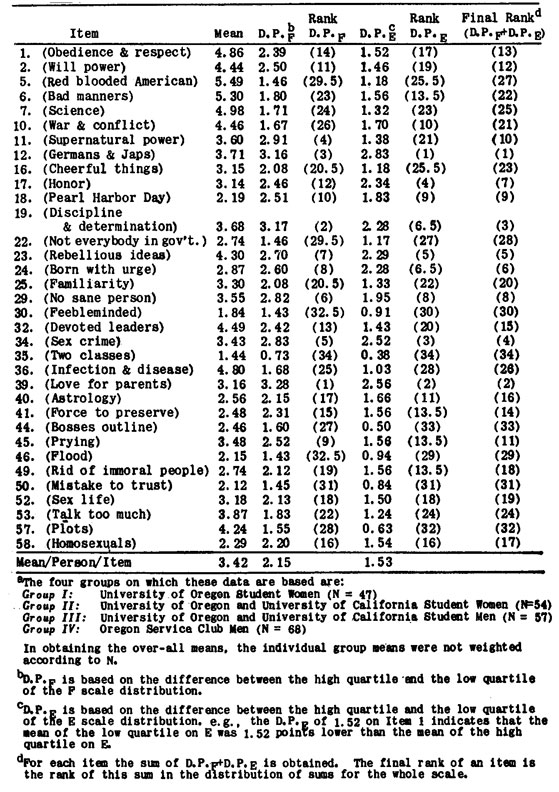
This table reproduces a historical item-analysis output for the F-scale, listing example item themes alongside descriptive statistics and discrimination indices. It helps students see that the F-scale is not just a concept but a specific questionnaire instrument built from many items whose quality can be evaluated psychometrically. Source
This was designed to measure authoritarian traits and attitudes.
F-scale: A questionnaire designed by Adorno and colleagues to identify authoritarian traits, including respect for authority, conventional beliefs, and hostility toward out-groups.
People who scored highly on the F-scale tended to show more rigid and prejudiced attitudes. Adorno saw this as evidence that authoritarianism was a broad personality pattern, not just a single belief. In relation to obedience, the key idea is that people with higher authoritarianism should be more willing to accept commands from powerful figures.
Evaluation of the explanation
Supporting evidence
One strength is that some research has found a link between authoritarian traits and obedient behavior.
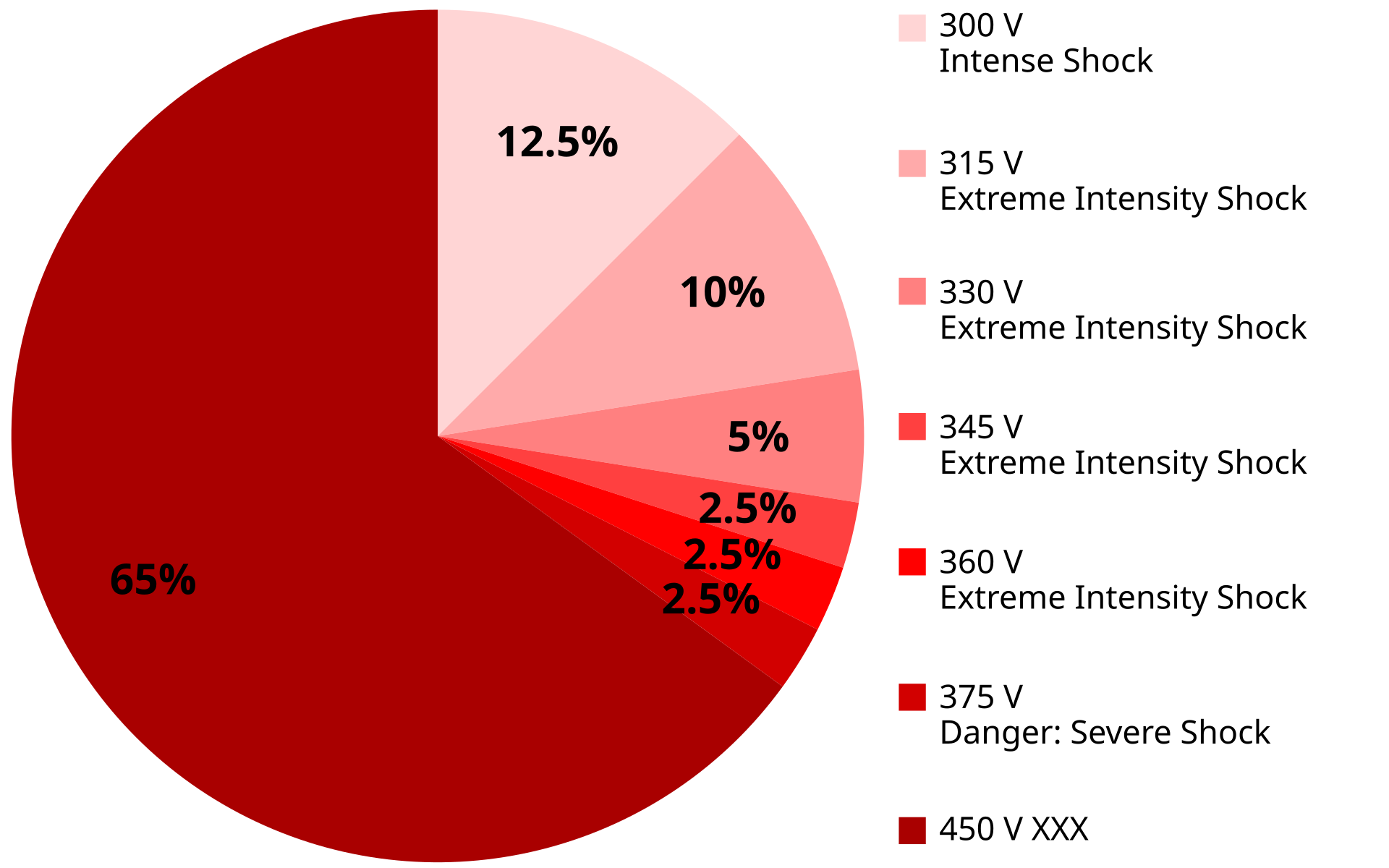
This pie chart summarizes the outcome of Milgram’s shock experiment by showing the proportion of participants who were fully obedient versus those who stopped before the maximum shock level. It provides a quick visual anchor for what “obedience rate” refers to when evaluating dispositional explanations of obedience. Source
Elms and Milgram interviewed participants who had taken part in Milgram’s obedience study and found that those who had been fully obedient tended to score higher on measures of authoritarianism than those who had refused.
This supports the idea that personality can play a role in obedience. It suggests that people are not all equally likely to obey, and that stable traits may help explain why some individuals are more submissive to authority than others.
The explanation also has face validity because it connects obedience with a broader pattern of attitudes, including respect for hierarchy and hostility toward those seen as lower in status.
Problems and limitations
A major weakness is that the evidence is often correlational. Even if authoritarianism and obedience are linked, this does not prove that authoritarian personality causes obedience. Other factors, such as education, social background, or general political attitudes, might influence both.
Another criticism concerns the F-scale itself. Many items were worded so that agreement indicated authoritarianism, which creates a risk of response bias, especially acquiescence bias. This means some people may score highly simply because they tend to agree with statements, not because they are genuinely authoritarian.
The explanation has also been criticized for political bias. Adorno’s theory focused heavily on right-wing authoritarianism and linked authoritarianism closely with fascist attitudes. Critics argue that rigid obedience and intolerance may also appear in people with other political views, so the original account may be too narrow.
Finally, the theory cannot fully explain why large numbers of ordinary people may obey in certain circumstances.
If obedience were mainly caused by authoritarian personality, highly obedient behavior should be limited to a particular type of person. In practice, obedience can be shown by many different individuals, suggesting that personality is only part of the explanation and may be more useful for explaining especially extreme forms of obedience.
Practice Questions
Outline two characteristics of the authoritarian personality. (2 marks)
1 mark for each accurate characteristic, up to 2 marks.
Credit any two of the following:
strong submission to authority
rigid conventional beliefs
hostility toward people of lower status or out-groups
preoccupation with power and status
black-and-white or inflexible thinking
Discuss the authoritarian personality as a dispositional explanation for obedience. (6 marks)
AO1 Knowledge and understanding (up to 3 marks):
obedience is explained by internal personality factors
Adorno and colleagues proposed the authoritarian personality
characteristics include submission to authority, conventionalism, and hostility to inferiors
linked to harsh parenting and childhood development
authoritarianism measured using the F-scale
AO3 Evaluation/discussion (up to 3 marks):
support from Elms and Milgram: more obedient participants showed higher authoritarian traits
evidence is correlational, so causation cannot be established
F-scale may suffer from acquiescence bias or other measurement problems
theory may be politically biased or too focused on right-wing views
does not fully explain widespread obedience among ordinary people
FAQ
No. A person can be strict, organized, or rule-focused without having the full pattern described in authoritarian personality theory.
The theory refers to a broader cluster of traits, including:
strong submission to authority
hostility toward lower-status groups
rigid conventional attitudes
discomfort with ambiguity
So ordinary self-discipline is not enough on its own.
The topic became highly important after World War II, when psychologists wanted to understand how ordinary people could support or participate in oppressive regimes.
Researchers were asking questions such as:
Why do some people accept extreme authority so readily?
Why are prejudice and obedience sometimes linked?
Can certain personality patterns make anti-democratic attitudes more likely?
This historical context strongly shaped Adorno’s original theory.
Many psychologists think they can. Adorno’s original account focused mainly on right-wing authoritarianism, but later researchers argued that rigid obedience and intolerance can attach to different belief systems.
What seems crucial is not only the label of the ideology, but whether it involves:
absolute certainty
intolerance of disagreement
strong punishment of deviance
unquestioning loyalty to authority
This is why the idea remains debated in modern psychology.
Modern researchers often use newer questionnaires rather than Adorno’s original F-scale.
These measures may:
use more balanced wording
separate different traits more clearly
focus on ideas such as authoritarian submission, authoritarian aggression, and conventionalism
One common approach is the study of right-wing authoritarianism, which treats authoritarianism as a measurable attitude pattern rather than a fixed clinical type.
They are not necessarily permanent. Some researchers treat authoritarianism as fairly stable, but modern evidence suggests it can shift with experience and context.
Possible influences include:
aging
education
perceived social threat
economic insecurity
major political events
So a person may become more or less authoritarian over time, even if they show some consistent tendencies across situations.