

AP Syllabus focus: ‘Avogadro’s number (6.022 × 10^23 per mole) links the amount of substance in moles to the number of atoms, molecules, ions, or formula units present.’
Chemistry connects measurable laboratory quantities to invisible particles. Avogadro’s number provides the bridge between macroscopic moles and microscopic entities, letting you translate “how much” into “how many.”
Core idea: counting by the mole
Amount of substance and Avogadro’s number
Mole (mol): The amount of substance containing exactly specified particles (entities).
Because atoms and molecules are far too small to count directly, chemists count them indirectly by counting moles.
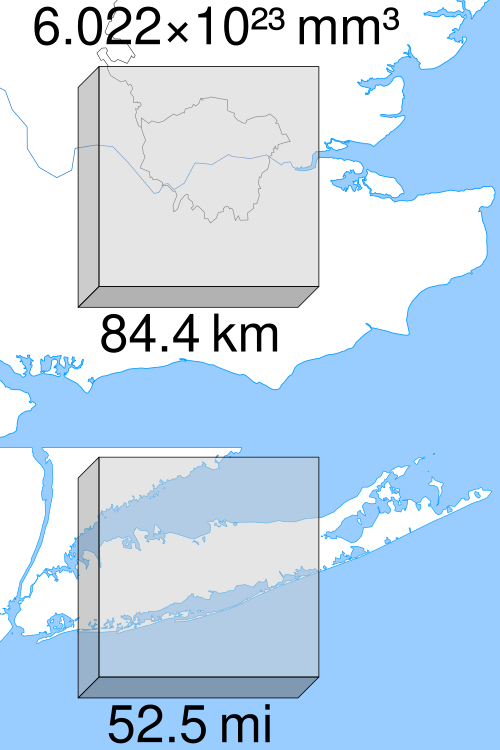
A scale visualization of Avogadro’s number: it represents a mole as small cubes aggregated into a much larger cube, overlaid on real maps for size context. The purpose is to build intuition for how extraordinarily large “one mole” is, even though the entities themselves are microscopic. Source
The key constant is Avogadro’s number (also called the Avogadro constant, ), which tells you the number of entities per 1 mole.
Avogadro’s number (): entities per mole; the conversion factor between moles and number of particles.
An “entity” must be clearly identified, since different substances are counted differently:
Atoms (e.g., He atoms in helium gas)
Molecules (e.g., HO molecules in water)
Ions (e.g., Na ions in sodium chloride)
Formula units (e.g., NaCl formula units in an ionic solid)
The mole–particle conversion relationship
The central quantitative link is between amount of substance () and number of particles (). Always label what the particles are (atoms, molecules, ions, formula units) to avoid interpretation errors.
= number of entities (particles)
= amount of substance (mol)
= Avogadro’s number ()
This relationship works for any pure substance as long as the entity is specified correctly.
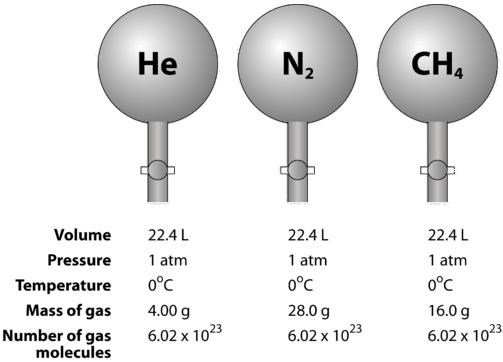
Diagram illustrating Avogadro’s hypothesis: equal volumes of different gases at the same temperature and pressure contain the same number of molecules. It visually reinforces that “1 mol” corresponds to the same particle count (), even though the gases have different molar masses and therefore different sample masses. Source
Choosing the correct “particle” to count
Elements: atoms vs molecules
Some elements are naturally monatomic (e.g., Ne), while others exist as molecules (commonly diatomic, e.g., O). When you are asked for “number of particles,” identify whether the particles are atoms or molecules.
Common interpretation rules:
If the substance is written as a single element symbol (e.g., Fe), particles are atoms.
If the substance is written as a molecular formula (e.g., O, P), particles are molecules unless the question explicitly asks for atoms.
Compounds: molecules vs formula units
For covalent compounds (e.g., CO), the representative particles are molecules. For ionic compounds (e.g., CaF), the representative particles are formula units, not molecules.
Use these distinctions carefully:
Molecules are discrete units with a specific count of atoms covalently bonded.
Formula units represent the simplest whole-number ratio of ions in an ionic lattice (there are no individual “NaCl molecules” in solid NaCl).
Ions and total particle counts
Questions may ask for the number of a specific type of ion rather than formula units. In that case:
First interpret the formula unit composition (e.g., 1 Ca and 2 F per CaF formula unit).
Then scale the count of ions relative to the count of formula units.
Using units and language precisely
Conversion-factor mindset
Avogadro’s number functions like a “particles-per-mole” conversion:
multiply by to convert mol → particles
divide by to convert particles → mol
= amount of substance (mol)
= number of entities (particles)
= Avogadro’s number ()
What to state in your setup
To communicate clearly (and earn full credit), consistently include:
the identity of the entity (atoms, molecules, ions, formula units)
the unit with
the correct interpretation of what “particle” means in context (especially for ionic solids and diatomic elements)
Practice Questions
(2 marks) How many molecules are present in of CO?
Uses with (1)
Correct value molecules (allow suitable rounding) (1)
(5 marks) A sample contains formula units of CaF. Determine: (a) the amount of CaF in moles, and (b) the number of fluoride ions present.
(a) Uses (1)
Substitutes and correctly (1)
Calculates (allow 0.498–0.500 depending on rounding) (1)
(b) Recognises F per CaF formula unit (1)
Calculates F ions (1)
FAQ
It is defined exactly as $6.02214076\times10^{23}\ \text{mol}^{-1}$. Many AP-level problems use $6.022\times10^{23}$ for convenience, so match the precision expected in the question.
They are often used interchangeably. More precisely, Avogadro’s constant $N_A$ has units of $\text{mol}^{-1}$, whereas “Avogadro’s number” may refer to the numerical value $6.02214076\times10^{23}$.
Because it tells you how many entities correspond to 1 mole. Dimensional reasoning: $(\text{mol})\times(\text{entities}\ \text{mol}^{-1}) = \text{entities}$.
Read the wording carefully. If it says “formula units of NaCl,” treat as NaCl units. If it says “ions in solution,” treat particles as Na$^+$ and Cl$^-$ separately, using the dissociation ratio to relate ion count to formula units.
Because “number of particles” is ambiguous without the entity type. Writing “$1.2\times10^{23}$ particles” does not show whether you mean atoms, molecules, ions, or formula units, which can change the interpretation and subsequent steps.
